
Handmade Product Quality Standards for Small Makers
Handmade product quality standards are written, measurable expectations covering materials, construction, finish, safety, and allowable variation for each item you sell. The single first action: write a one-page product specification before you list anything for sale.
Start here:
- Write a product spec with at least three measurable criteria (dimensions, material grade, finish condition).
- Collect a certificate of analysis or test report from every material supplier.
- Identify whether your product is a children’s item, textile, or food-contact good — those categories trigger specific U.S. compliance steps.
- Keep one approved physical sample per product as your reference standard.
Key Takeaways
Handmade product quality standards require a written spec, documented supplier materials, and a clear inspection process before you sell a single unit.
| Point | Details |
|---|---|
| Write a spec first | Document at least three measurable criteria per product before listing it for sale. |
| Know your compliance tier | Children’s products require a CPC and CPSC-accepted lab testing; adult decorative items need supplier COAs at minimum. |
| Use multiple reference samples | Keep at least two approved physical samples per product to define the acceptable variation range. |
| Maintain batch traceability | Link raw material lot IDs to finished batch IDs so you can identify affected units if a quality issue arises. |
| Latviancandles molds reduce variation | Purpose-built silicone molds control final shape and surface pattern, making dimensional specs easier to meet consistently. |
Table of Contents
- What do quality standards actually mean for handmade goods?
- What should every handmade product quality standard include?
- What U.S. regulations apply to handmade sellers?
- How do you build a practical QC process for a small shop?
- How do you choose materials and decide when to test?
- How do you produce compliant labels and keep the right records?
- How do you scale production without losing handmade quality?
- Applying quality standards to beeswax candles: a practical example
- One-page checklist: set a quality standard for a new product
- Durability and performance testing by product category
- Safety and ergonomics beyond regulatory minimums
- How to handle quality issues and product recalls
- What does implementing quality standards actually cost?
- Why quality standards protect your craft, not constrain it
- Consistent molds and measured materials support repeatable quality
- Useful primary sources and agency links
- Sources
- FAQ
What do quality standards actually mean for handmade goods?
For handmade goods, quality standards are not a single certification number. They are a documented set of measurable expectations across five dimensions: material authenticity, structural integrity, finish and appearance, function and safety, labeling, and traceability.
The key difference from mass-production specs is tolerance. A factory part may allow ±0.1 mm. A hand-thrown ceramic bowl may allow ±5 mm in rim diameter, and that range is intentional and documented. Inspection programs for natural-material products recommend setting multiple reference samples and clear visual acceptance ranges rather than a single “golden sample,” precisely because natural variation is real and expected.
The U.S. regulatory landscape adds a second layer. Entities and rules every artisan seller must know:
- CPSC (U.S. Consumer Product Safety Commission): the federal agency that enforces product safety rules.
- CPSIA (Consumer Product Safety Improvement Act): applies to children’s products; requires CPSC-accepted lab testing and a Children’s Product Certificate (CPC).
- ASTM: publishes voluntary safety standards (e.g., ASTM F963 for toys) that CPSIA often references.
- OEKO-TEX: a third-party textile certification confirming materials are free from harmful substances.
- California Proposition 65: requires warnings for products containing listed chemicals above set thresholds when sold in California.
- 16 CFR Part 303: federal textile fiber identification and labeling rules.
- 19 CFR Part 134: country-of-origin marking requirements for imported goods.
- CPC (Children’s Product Certificate): a written document certifying a children’s product meets applicable safety rules.
Handmade goods sold in the U.S. are subject to the same safety, labeling, and testing requirements as mass-produced items. Being a solo maker or a small studio does not create a blanket exemption.
Pro Tip: Add one sentence to every product listing: “Each piece is made by hand; minor variations in [dimension/color/texture] are normal and reflect the nature of handcrafted production.” This sets accurate expectations and reduces return disputes.
What should every handmade product quality standard include?
A usable spec sheet covers the following fields for each product:
- Product name and SKU
- Intended use and target user (adult, child, food contact, decorative only)
- Raw materials: supplier name, grade, batch ID, and any certificate (OEKO-TEX number, COA reference)
- Nominal dimensions and weight with stated tolerance ranges
- Color references (Pantone, RAL, or a physical swatch)
- Finish instructions and acceptable finish condition
- Functional criteria (burn time for candles, load capacity for shelving, closure strength for bags)
- Safety requirements (chemical limits, flammability class, age warnings)
- Packaging and labeling requirements (fiber content, care symbols, country of origin, manufacturer contact)
Beyond the spec fields, you need physical reference materials. Multiple approved reference samples and photo-based acceptance ranges outperform a single sample because they show the acceptable range, not just the ideal. Keep at least two approved samples per product: one at the lower bound of acceptable quality, one at the upper.
Write acceptance and rejection rules in plain language so any inspector or customer service rep can apply them without judgment calls. Example: “Surface pitting: acceptable if fewer than three pits, each smaller than 1 mm, on any visible face. Reject if any pit exceeds 1 mm or if more than three pits appear on one face.”
Sample tolerance table:
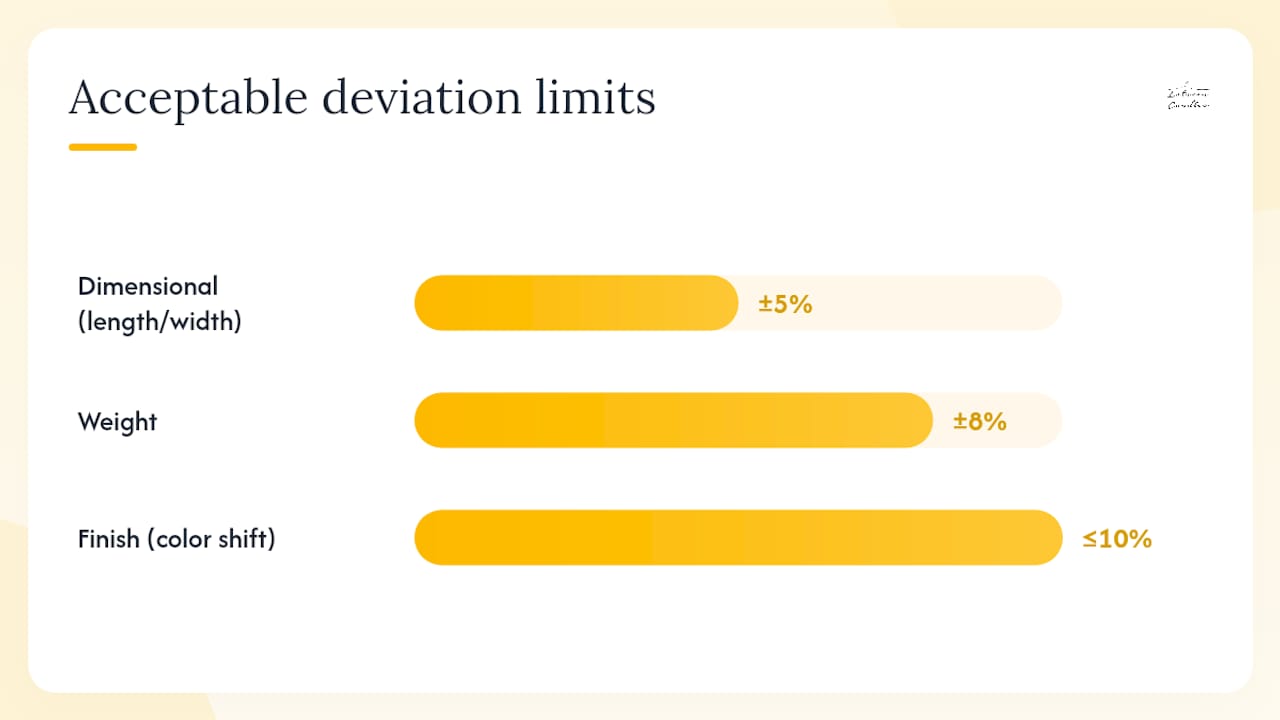
| Quality Dimension | Acceptable Range | Reject Condition |
|---|---|---|
| Dimensional (length/width) | Nominal ±5% | Any measurement outside ±5% |
| Finish/appearance | Minor color shift, no cracks | Cracks, chips, or color shift >10% from reference swatch |
| Material defects | Up to 2 minor inclusions per unit | Any structural inclusion or foreign material |
| Weight | Nominal ±8% | Outside ±8% of stated weight |
What U.S. regulations apply to handmade sellers?
Handmade and handicraft items sold in the U.S. face the same product safety, labeling, certification, and testing requirements as mass-produced goods. The rules below are the ones most likely to affect small makers.
CPSIA and children’s products: If your product is designed or marketed for children under 12, it must comply with CPSIA. That means designing to an applicable ASTM standard, testing with a CPSC-accepted third-party lab, issuing a Children’s Product Certificate (CPC), and attaching a permanent tracking label. Small-batch manufacturer status may reduce some testing frequency requirements, but it does not eliminate the CPC requirement.
Key compliance checkpoints:
- CPSC general conformity: Non-children’s products must still meet applicable CPSC safety rules (e.g., flammability, sharp edges, toxic substances).
- 16 CFR § 23.2: Labeling a product “handmade” is unfair or deceptive unless shaping, forming, finishing, and decoration were accomplished by hand labor or manually controlled methods for each individual item.
- 16 CFR Part 303: Textile products sold in the U.S. must carry fiber content (by percentage), manufacturer name or RN number, and country of origin.
- 19 CFR Part 134: Imported goods or goods with foreign-origin components must be marked with country of origin in a conspicuous location.
- California Proposition 65: Some small-business exemptions exist, but makers selling into California should evaluate whether their materials contain any of the 900+ listed chemicals above threshold levels. Businesses with fewer than 10 employees are generally exempt, but the product itself may still require a warning if a distributor or retailer triggers the obligation.
When third-party lab testing is mandatory:
- Children’s products (CPSIA): always required at a CPSC-accepted lab.
- Flammability (16 CFR Part 1610 for textiles): required for clothing and fabric items.
- Lead and phthalate limits in children’s products: lab-verified, no exceptions.
Reducing testing burden responsibly: Source materials that carry existing certifications. OEKO-TEX Standard 100 certification on fabric or fill material means the supplier has already tested for harmful substances. Request supplier certificates of analysis (COAs) and keep them on file. For low-risk adult decorative items, documented supplier COAs and material traceability often satisfy compliance needs without additional lab spend.
How do you build a practical QC process for a small shop?
A workable quality control system for a small maker has four stages: incoming materials check, in-process inspection, finishing check, and final inspection before packaging.
SOP template (single product):
- Incoming materials: Verify supplier COA matches batch ID. Check material against approved reference swatch or sample. Log batch ID and date received.
- Process checkpoint 1 (preparation): Confirm material weight or measure matches spec. Record any deviation.
- Process checkpoint 2 (forming/assembly): Check dimensions against spec tolerance. Flag and set aside any out-of-tolerance units.
- Finishing check: Inspect surface finish against reference photos. Confirm color within acceptable range.
- Final inspection: Full spec check against the product spec sheet. Confirm labeling is complete and correct.
- Packaging: Verify packaging integrity and that all required label elements are present.
Sampling plan for small batches:
- Batches of 1–10 units: inspect 100%.
- Batches of 11–50 units: inspect a minimum of 10 units or 20%, whichever is greater.
- Batches of 51–200 units: inspect a minimum of 20 units.
- Defect threshold: if more than 2% of inspected units are rejected, hold the full batch for review.
When a unit fails inspection, complete a nonconformance report (NCR) with: unit ID, defect description, probable cause, and corrective action taken. Review NCRs monthly to spot recurring issues. If the same defect appears in three consecutive batches, treat it as a process problem, not a one-off.
Records to keep: incoming material logs, in-process inspection notes, final inspection records, NCRs, and corrective action summaries. Retain for a minimum of three years, or longer if your product category has specific regulatory retention requirements.
Pro Tip: For makers selling on Etsy or similar platforms, inspect every unit in batches under 20 and use a photo-based final check — photograph each finished item against your reference sample before packaging. This creates a timestamped record and catches finish issues before shipment.
How do you choose materials and decide when to test?
Material risk determines your testing strategy. Group your materials into three categories:
- Low risk: Adult decorative items with no skin contact, no ingestion risk, no flammability concern. Supplier COAs and documented traceability are usually sufficient.
- Medium risk: Textiles, adult jewelry, items with skin contact, or products with dyes. Request OEKO-TEX or equivalent certificates. Supplier test reports covering relevant chemical limits are the minimum.
- High risk: Children’s products, food-contact items, candles with fragrance oils, items with surface coatings. Third-party accredited lab testing is typically required or strongly advisable.
What to request from every supplier:
- Certificate of analysis (COA) for each material batch
- Test reports covering substance limits relevant to your product category (lead, cadmium, phthalates, formaldehyde)
- OEKO-TEX Standard 100 certificate (for textiles and fills)
- Material batch or lot ID that matches the COA
- For amber or natural stone components, physical and chemical identification documentation (see amber authenticity verification as a model for natural material verification)
Decision flow: supplier docs vs. lab testing:
- If the product is low-risk and the supplier provides a current COA with relevant test data: accept supplier documentation, file it, and document your decision.
- If the product is medium-risk or the supplier cannot provide adequate documentation: send a sample to an accredited lab. Look for labs that are ILAC/IAF signatories, which signals recognized accreditation.
- If the product is high-risk (children’s, food contact): accredited lab testing is required regardless of supplier documentation.
Cost-saving tactic: source pre-tested components. A wick supplier that provides lead-free certification and a COA eliminates one test from your burden. A beeswax supplier with a purity certificate reduces the scope of any lab work you commission.
| Material Category | Minimum Documentation | Lab Testing Required? |
|---|---|---|
| Adult decorative (no skin contact) | Supplier COA | No, if COA covers relevant limits |
| Textiles / adult jewelry | OEKO-TEX or supplier test report | Sometimes, if supplier docs are insufficient |
| Children’s products | Supplier COA + CPSC-accepted lab report | Yes, always |
| Food-contact / candles with fragrance | COA + fragrance safety data sheet | Strongly advisable |
How do you produce compliant labels and keep the right records?
A compliant label for a U.S. handmade product typically needs:
- Fiber content by percentage (textiles, per 16 CFR Part 303)
- Manufacturer name and address or registered number (RN)
- Country of origin (“Made in USA” or country of manufacture, per 19 CFR Part 134)
- Care instructions (textiles)
- Age warnings where applicable (“Not suitable for children under 3 years”)
- Safety warnings required by CPSC rules or Prop 65
Minimum record set per product:
- Signed product specification sheet (current version, dated)
- Approved sample photos (at least two angles, dated)
- Supplier COAs and test reports for all materials
- CPC (if a children’s product), with lab report reference
- Batch production records (date, quantity, operator)
- QC inspection records for each batch
Store records digitally with a consistent file-naming convention: [ProductSKU]_[DocumentType]_[Date].pdf. Example: BW-PILLAR-01_COA_2025-03.pdf. Retain all compliance records for at least three years; retain CPC-related records for the product’s full market life plus three years.
Children’s Product Certificate (CPC): A CPC is a written document, not a government-issued certificate. You create it. It must identify the product, the applicable CPSC rules, the testing lab, and the test report. The CPSC provides a CPC template and guidance on its website.
Tracking labels for children’s products must be permanently attached and include: manufacturer name, location, date of manufacture, and a batch or lot identifier.
Pro Tip: For small-batch runs, Avery label templates in standard sizes (2" x 4" or 1" x 2.625") work for most handmade product labels and are compatible with standard laser or inkjet printers. Design the label in Canva or Adobe Express, export as PDF, and keep the source file versioned.
How do you scale production without losing handmade quality?
Consistency at scale depends on three things: trained people, documented standards, and physical tooling that reduces variation.
Training checklist for new makers or contract artisans:
- Review the product spec sheet and approved reference samples together.
- Demonstrate each process step with measurement at each checkpoint.
- Have the trainee complete one full unit under observation.
- Inspect the trainee’s first three independent units against the spec.
- Conduct a safety briefing covering material handling, tool use, and workspace requirements.
- Sign off on the training record before the artisan works on production batches.
Large-scale handmade programs use matching, written specs with photos, sample approval, production monitoring, and final inspections to deliver consistency across many makers. The same structure scales down to a two-person studio.
Audit cadence for small shops:
- Weekly: spot-check 3–5 finished units from the current batch against the spec.
- Monthly: full review of NCRs, corrective actions, and any customer complaints.
- Quarterly: review and update spec sheets if materials or suppliers have changed.
Technology options that fit a small budget:
- Google Forms or Airtable for digital inspection records.
- Google Drive or Dropbox for versioned spec sheets and photo references.
- A shared photo album (Google Photos, iCloud) for reference sample images accessible to all makers.
Physical tooling reduces variation without removing the handmade character of a product. Jigs, dedicated molds, and consistent measuring tools (calipers, scales) keep dimensions within spec even when different hands do the work. For candle makers, using the same silicone mold for every pour controls final shape, height, and surface texture without automating the process. See how to use molds effectively for practical guidance on integrating mold-based tooling into a repeatable SOP.
Applying quality standards to beeswax candles: a practical example
Beeswax candles illustrate how the spec, SOP, and inspection framework works in practice.
Sample spec sheet for a beeswax pillar candle:
| Spec Field | Value |
|---|---|
| Product name / SKU | Beeswax Pillar Candle / BW-PILLAR-01 |
| Wax type | 100% natural beeswax, purity COA required |
| Wick type | Lead-free cotton wick, sized to diameter |
| Nominal dimensions | 3" diameter x 6" height, ±5% |
| Finish | Smooth, natural honey color; minor bloom acceptable |
| Fragrance | Unscented or fragrance-safe oil with safety data sheet |
| Packaging | Kraft box, tissue wrap; label per spec |
| Burn test | 4-hour test burn on 5% of batch; no tunneling, stable flame |
SOP step list with inspection points:
- Weigh beeswax to spec; verify COA batch ID matches current stock.
- Melt wax to correct temperature (check with calibrated thermometer).
- Prepare mold: clean, dry, wick centered and secured.
- Pour at correct temperature; record pour date and batch number.
- Cool at room temperature for the specified time; do not disturb.
- Demold; inspect surface for cracks, pits, or wick misalignment.
- Trim wick to 1/4 inch; verify against spec.
- Conduct burn test on sample units from each batch.
- Inspect finish against reference photos; approve or reject.
- Apply label; verify all required fields are present.
Supplier documents that matter for beeswax candles:
- Beeswax purity COA (confirm no adulteration with paraffin)
- Wick supplier lead-free certification
- Fragrance oil safety data sheet (if scented), confirming skin-safe and combustion-safe status
- Mold material certification (food-grade or candle-grade silicone)
Natural beeswax bloom (a white film that develops on the surface) is normal and acceptable. Document it in your spec as an allowable variation and include a photo reference showing the acceptable range. Customers who receive a clear explanation in the product listing rarely treat bloom as a defect. For more on the material properties that make beeswax a distinctive craft medium, see beeswax candles as a craft.
Using a consistent silicone mold, such as the Bees on Cells mold from Latviancandles, controls the final shape and surface pattern across every pour, which reduces the dimensional variation your inspection has to manage.
One-page checklist: set a quality standard for a new product
Use this checklist to create a product-specific quality standard from scratch:
- Define the product: name, SKU, intended use, and target user.
- Pick 3–5 critical specs: the dimensions, weight, material grades, or performance criteria that matter most to the buyer.
- Select reference samples: collect at least two physical samples representing the acceptable range.
- List required supplier documents: COA, test report, OEKO-TEX certificate, or equivalent for each material.
- Choose your testing strategy: supplier docs only (low-risk), or third-party lab (medium/high-risk).
- Set inspection steps: incoming materials, in-process, finishing, final.
- Create label fields: list every required label element for your product category.
- Decide record retention: minimum three years for most products; longer for children’s products.
Converting the checklist into a spec sheet:
- Use a single-page template with one row per spec field.
- Attach reference photos directly to the document (embed or link to a shared folder).
- Version the document:
v1.0,v1.1, etc., with a date on each version.
Prioritizing by legal risk and customer impact:
- Children’s products and textiles: address labeling and testing first.
- Adult decorative items: focus on finish and dimensional specs first; labeling second.
- Food-contact or skin-contact items: fragrance and chemical safety documentation first.
Pro Tip: To estimate testing cost before committing: contact two CPSC-accepted labs (SGS, Bureau Veritas, and Intertek all operate in the U.S.) and request a quote for the specific ASTM standard your product must meet. If the quote exceeds your margin on a small batch, source a pre-certified component to eliminate that test line.
Durability and performance testing by product category
Performance testing requirements vary by what the product does and who uses it. The goal is to verify that the item holds up under realistic use conditions, not just looks good at the point of sale.
Candles: Conduct a minimum 4-hour burn test on a sample from each batch. Check for tunneling, excessive drip, flame height stability, and wick behavior. ASTM F2417 covers candle fire safety; it is a voluntary standard but widely referenced by retailers and insurers.
Textiles and soft goods: Test seam strength, colorfastness (AATCC test methods), and dimensional stability after washing. For children’s clothing, CPSIA requires flammability testing per 16 CFR Part 1610.
Jewelry and wearables: Check clasp strength, plating adhesion, and sharp-edge assessment (ASTM F963 for children’s jewelry). For natural stone or amber components, physical identification tests confirm material authenticity. Practical identification tests for natural materials provide a useful model for verifying that a claimed material is what the supplier says it is.
Wood and structural items: Test load capacity, joint integrity, and surface finish durability (scratch resistance, moisture resistance). ASTM D4366 covers hardness of organic coatings; relevant for painted or lacquered wood goods.
Ceramics and pottery: Check for food-safe glaze (lead and cadmium limits per FDA guidelines), thermal shock resistance, and structural integrity under normal use loads.
For each category, document the test method, the sample size tested, the pass/fail criteria, and the results. Keep test records with the batch documentation.
Safety and ergonomics beyond regulatory minimums
Regulatory compliance sets a floor. Ergonomic and user safety considerations above that floor protect both the buyer and your reputation.
Weight and grip: Items held or carried repeatedly (bags, tools, pottery) should be evaluated for grip comfort and weight distribution. A ceramic mug that is too heavy when full, or a handle diameter that does not fit average adult hands, generates returns even when the product is technically compliant.

Sharp edges and protrusions: Run a finger-pressure test on any edge or corner that a user will contact during normal use. Sand, file, or redesign any edge that catches or causes discomfort. For children’s products, ASTM F963 defines specific sharp-edge and sharp-point criteria; for adult products, apply the same physical test as a practical standard.
Stability: Freestanding items (candles, ceramics, decorative objects) should not tip under a 15-degree tilt test. A candle that tips easily is a fire hazard regardless of whether a regulation specifically addresses it.
Fragrance and chemical sensitivity: Even for products not subject to Prop 65 warnings, disclose fragrance ingredients in product listings. A growing segment of buyers has fragrance sensitivities. Listing “unscented” or providing a fragrance ingredient list reduces complaints and returns.
Packaging safety: Avoid packaging materials that create suffocation or ingestion risks, particularly for products that may be gifted to households with children. Polybags over a certain size require suffocation warning labels under ASTM D4169 and some state rules.
Document your ergonomic and safety review in the product spec as a checklist section, separate from the regulatory compliance section. This creates a record that you considered user safety beyond the minimum.
How to handle quality issues and product recalls
Every maker needs a documented process for handling defects and, in the worst case, a product recall.
When a quality issue surfaces:
- Identify the affected batch using your batch production records.
- Pull all unsold units from that batch for inspection.
- Complete a nonconformance report: defect description, batch ID, quantity affected, probable cause.
- Decide on disposition: rework, destroy, or quarantine pending further investigation.
- Notify any customers who received units from the affected batch if the defect poses a safety risk.
- Document the corrective action and update the SOP or spec to prevent recurrence.
CPSC recall process for small makers: If a product poses a substantial product hazard, the CPSC requires manufacturers to report under Section 15(b) of the Consumer Product Safety Act. The CPSC’s Saferproducts portal is where consumers report incidents; monitor it for your product category. If you receive multiple incident reports involving the same product, consult the CPSC’s recall handbook and consider voluntary corrective action before a mandatory recall is initiated.
Record-keeping for recall readiness:
- Maintain a customer purchase log with product SKU, batch ID, and shipping address for every order.
- Keep batch production records that link raw material lot IDs to finished product batch IDs.
- Store supplier COAs and test reports so you can demonstrate material compliance if questioned.
A recall is far less damaging when you can identify exactly which customers received which batch. Batch traceability is the single most valuable record a small maker can maintain.
What does implementing quality standards actually cost?
Quality standards have real costs, and planning for them prevents budget surprises.
One-time setup costs:
- Writing spec sheets and SOPs: primarily time. Budget 2–4 hours per product for the first version.
- Reference samples: the cost of producing or purchasing approved samples, typically one to three units per product.
- Label design and printing setup: $50–$200 for a professional label design; label printing per unit is usually under $0.10 for standard sizes on a home printer.
Ongoing costs:
- Third-party lab testing: costs vary by test scope. A basic CPSIA test battery for a children’s product typically runs several hundred dollars per product at accredited labs such as SGS, Bureau Veritas, or Intertek. Request itemized quotes before committing.
- Supplier COAs: often provided at no charge by reputable suppliers; factor in the time to request and file them.
- Record storage: cloud storage (Google Drive, Dropbox) costs under $15 per month for most small makers.
Cost reduction tactics:
- Source OEKO-TEX certified materials to eliminate redundant textile chemical testing.
- Use supplier COAs for low-risk products and reserve lab spend for high-risk categories.
- Batch similar products for lab testing when they share the same materials and construction method.
- Take advantage of small-batch manufacturer provisions under CPSIA where applicable, which can reduce required testing frequency.
The business case is straightforward: documented quality standards reduce returns, support premium pricing, and protect against liability. Quality control helps handmade sellers command premium pricing and build buyer trust. The upfront cost of a spec sheet and a supplier COA file is small relative to the cost of a single product recall or a wave of negative reviews.
Why quality standards protect your craft, not constrain it
The common objection to written standards is that they make handmade work feel industrial. That concern is understandable and wrong.
A spec sheet does not tell you how to make something. It records what you already know makes a good piece. The tolerance ranges you write down are the ranges you already work within intuitively. Writing them down does two things: it lets someone else make the product to your standard, and it gives you a defensible record when a customer claims a product was defective.
The makers who resist documentation tend to be the ones who are most confident in their craft. That confidence is the problem. A return rate that creeps up, a platform dispute over a “not as described” claim, or a single safety incident can erase months of reputation building. Standards do not constrain the craft; they protect it.
The practical mindset: treat your first spec sheet as a draft. Write it, use it for one production run, and revise it based on what you actually inspect. A living document that reflects real production is more useful than a perfect document that sits in a folder.
Consistent molds and measured materials support repeatable quality
For beeswax candle makers, dimensional consistency is one of the hardest specs to hit by hand. Pour temperature, cooling rate, and wick placement all affect the final shape. A purpose-built silicone mold removes the shape variable entirely, leaving you to control only the material and process variables.
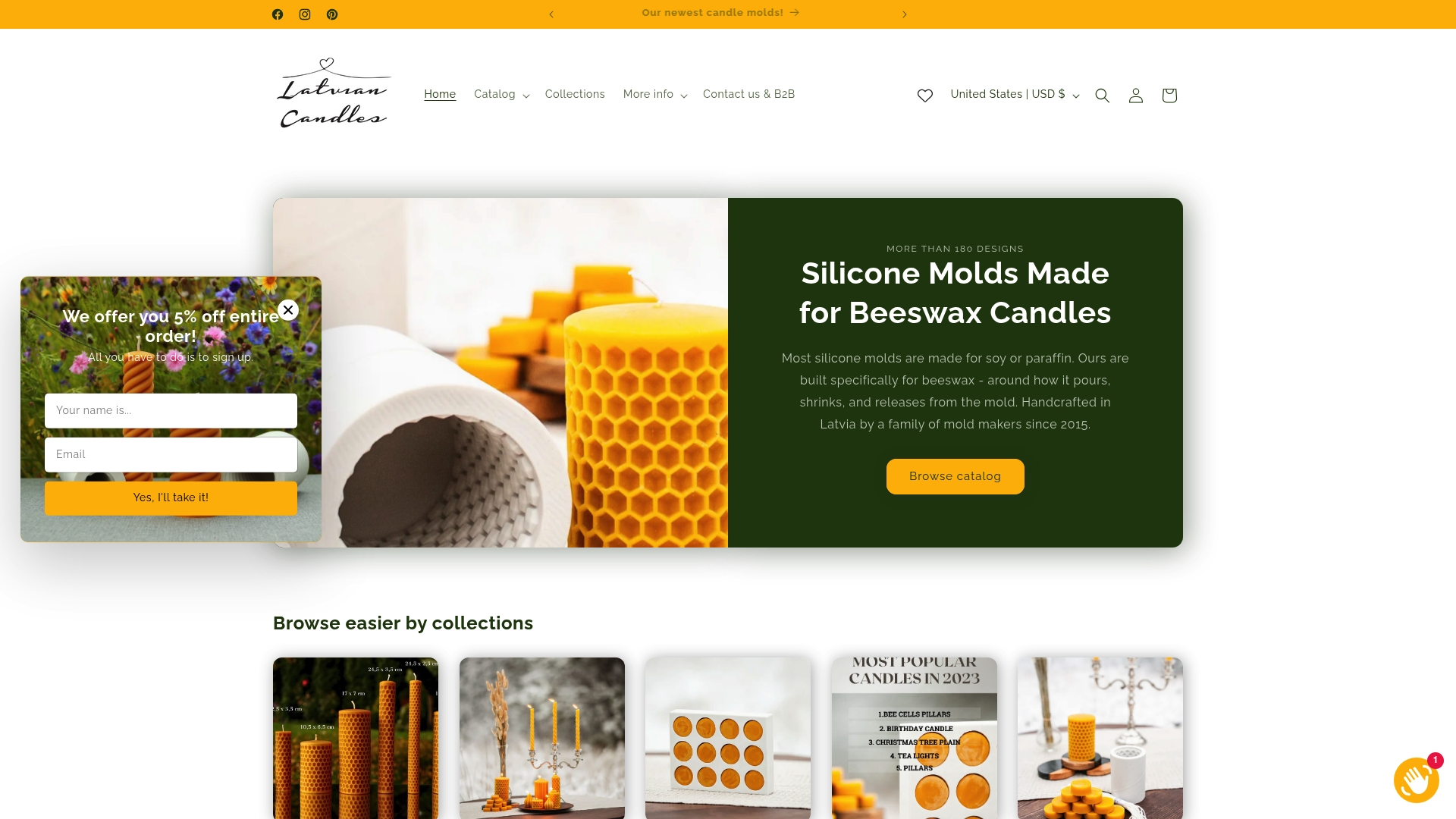
Latviancandles offers over 180 silicone mold designs built specifically for beeswax, including pillar, taper, tea light, and specialty shapes. Each mold controls the final dimensions and surface pattern of the candle, which means your spec sheet’s dimensional tolerances become easier to meet consistently across batches. The Bee Cells Pillars Solo mold and the Bees on Cells mold are two options that directly support the beeswax pillar spec example in this article. Browse the full range of beeswax silicone molds at Latviancandles to find the design that fits your product spec, and use the checklist in this article to build the SOP around it.
Useful primary sources and agency links
- CPSC — Consumer Product Safety Commission: The federal agency for product safety rules, recall guidance, and the CPC template. Start here for any children’s product question.
- CPSIA compliance guidance — ComplianceGate: Plain-language summary of U.S. handmade product regulations, CPSIA steps, and small-batch caveats.
- 16 CFR § 23.2 — “Handmade” labeling rule: The exact federal standard for when you may legally call a product “handmade.”
- California Prop 65 — business exemptions FAQ: Covers which businesses are exempt and what triggers a warning obligation for sellers into California.
- V-Trust — inspection guidance for handmade goods: Practical advice on reference samples, visual standards, and acceptance ranges for natural-material products.
- Handcrafted.ma — QA across 5,000+ artisans: A real-world model for written specs, sample approval, and production monitoring at scale.
- OEKO-TEX Standard 100: The certification to request from textile and fill material suppliers to reduce chemical testing burden.
This article is general information, not a substitute for advice from a qualified lawyer. Consult a qualified legal professional about your own circumstances before acting on anything here.
Sources
- 16 CFR § 23.2 - Misuse of the terms “handmade,” “hand-polished,” etc. | Electronic Code of Federal Regulations (e-CFR) | US Law | LII / Legal Information Institute
- Regulations For Handicrafts and Handmade Products in the United States | Compliance Gate
- Overcoming Inspection Challenges for Handicraft and Natural Material Products | V-Trust
- Quality Assurance Across 5,000+ Moroccan Artisans
- P65warnings
FAQ
What are examples of quality standards for handmade products?
Quality standards for handmade goods include dimensional tolerances (e.g., ±5% of stated size), material specifications (e.g., 100% natural beeswax with a purity COA), finish acceptance criteria (e.g., no cracks, minor color variation acceptable), and labeling requirements such as fiber content and country of origin under 16 CFR Part 303 and 19 CFR Part 134.
When is third-party lab testing required for handmade items?
Third-party testing at a CPSC-accepted lab is required for all children’s products under CPSIA, and for textiles subject to flammability rules under 16 CFR Part 1610. Adult decorative items with no skin or ingestion contact can often rely on supplier COAs instead.
How do you identify an authentic handcrafted product?
Authentic handcrafted products carry documentation: a maker’s name or registered number, country of origin, and material specifications. Under 16 CFR § 23.2, a product may only be labeled “handmade” if shaping, forming, finishing, and decoration for each item were accomplished by hand labor or manually controlled methods, and started from raw materials.
What is the difference between handmade and homemade?
“Handmade” is a regulated term under 16 CFR § 23.2 with a specific legal meaning: all shaping, forming, finishing, and decoration must be accomplished by hand labor or manually controlled methods, starting from raw materials. “Homemade” has no federal legal definition and generally refers to items made at home without implying a specific production method or compliance status.


