
How Candle Shape Changes Burn Time and What It Means for You
Shape matters, and it matters more than most burn-time charts admit. The controlling factors are surface-area-to-volume ratio, melt pool geometry, and how much liquid wax the wick can draw at once. Change the shape and you change all three simultaneously.
Here’s what that means in practice:
- Wide, shallow containers expose more wax surface relative to volume, so they melt faster per ounce.
- Tall, narrow pillars hold heat differently and tend to burn slower per ounce because less wax surface is exposed to the flame at any given time.
- Tapers burn fastest per unit volume since there’s no vessel wall holding heat and no reservoir insulating the melt pool.
An 8-ounce beeswax candle can run roughly 53 hours versus about 32 hours for the same weight in paraffin, and shape shifts that baseline further in either direction. If you’re designing molds rather than just buying candles, skip to the maker-guidance section below for the geometry adjustments that actually move the needle.
Key Takeaways
Candle shape controls burn time by governing surface-area-to-volume ratio, melt pool depth, and how much wax the wick can draw at once.
| Point | Details |
|---|---|
| Shape changes burn rate | Wide containers melt faster per ounce; tall pillars burn slower per ounce; tapers burn fastest per unit volume. |
| Melt pool physics rule everything | A wider, deeper melt pool against a heat-retaining wall speeds consumption; open-air pillars burn more conservatively. |
| Wick radius drives flame size | Research identifies wick radius as the dominant factor shaping flame height and width, more than wick length alone. |
| Heuristics need testing to confirm | Rules like the 1 inch-per-diameter estimate and 8:10 rule are starting points that break down with fragrance load or drafts. |
| Match mold shape and wick before pouring | Latviancandles’ 180-plus mold designs and starter kit pair shape choice with wick guidance suited to beeswax’s higher melting point. |
Table of Contents
- How Candle Shapes Affect Burn Time Through Melt Pool Physics
- How Do Common Candle Shapes Compare in Burn Time?
- What Are the 8:10 Rule and Other Burn-Time Heuristics?
- How Do You Test and Maintain a Candle for Consistent Burn Time?
- What Should Makers Know About Wick Sizing and Mold Geometry?
- What Does Controlled Testing Show About Shape and Burn Time?
- Does Candle Shape Affect Tunneling and Burn Safety?
- What We’ve Learned Designing Beeswax Molds
- Choosing a Mold Shape That Matches Your Burn-Time Goal
- Sources
- FAQ
How Candle Shapes Affect Burn Time Through Melt Pool Physics
A candle burns by pulling liquid wax up through the wick into the flame. Everything about how fast that happens traces back to the melt pool: the pool of liquefied wax sitting at the top of the candle. Its radius, its depth, and whether it touches a container wall all set the pace of consumption.
Surface-area-to-volume ratio is the first lever. A wide, shallow puddle of melted wax radiates and evaporates faster than a narrow, deep one holding the same volume, because more of it touches air and flame at once. That’s why a squat jar candle can burn through its wax faster, ounce for ounce, than a tall cylinder with the same weight of wax.
Wick loading is the second lever. A vessel candle traps heat against glass or ceramic walls, keeping the melt pool liquid and feeding the wick generously. A free-standing pillar has no wall to hold that heat, so it relies on its own mass and wick to sustain a stable pool, which is part of why pillars burn more conservatively.
Flame geometry ties it together. Research measuring actual candle flames found that flame width scales close to a quarter-power relationship with wick length, and wick aspect ratio affects whether the flame stays attached or gutters out. A thicker wick throws more heat down into the wax, widening the melt pool and accelerating consumption.
Picture three candles side by side: a pillar with a compact, self-contained melt pool; a container candle with a wide pool pressed against glass; and a taper with barely any pool at all, just a thin film feeding a lean flame. Same wax, three very different burn rates.
- Melt pool radius and depth set how much liquid wax is available to the wick at any moment.
- Surface-area-to-volume ratio determines how quickly that liquid wax evaporates and burns off.
- Container walls retain heat and widen the pool; open air on a pillar or taper limits it.
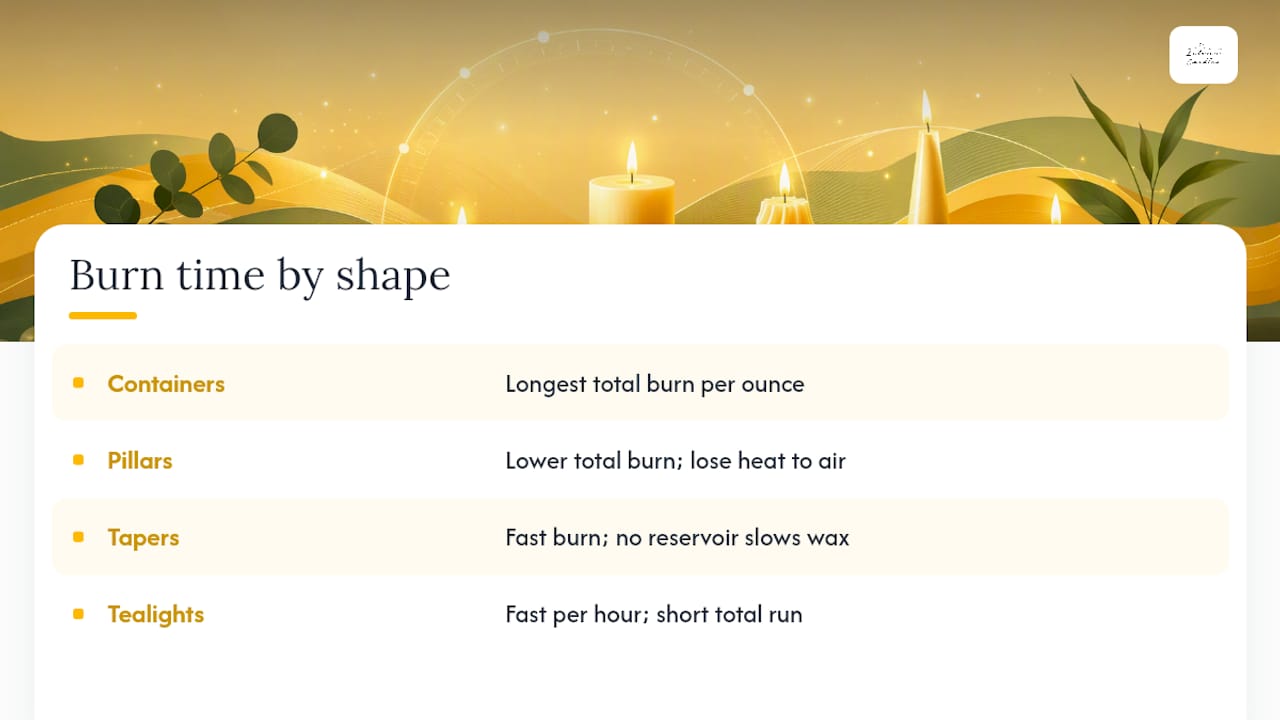
How Do Common Candle Shapes Compare in Burn Time?
Shape-by-shape expectations, relative to a same-weight reference candle in the same wax:
- Tapers burn fastest per unit volume. No vessel, minimal melt pool, and a lean flame that consumes wax quickly along the length of the stick.
- Pillars burn slower per ounce than containers because there’s no wall trapping heat, and their higher surface-area-to-volume ratio at the base compared to the tip changes the rate as they burn down. Weak wicks or drafts can cause them to slump or lose their edges before they burn through fully.
- Tealights burn fast per hour but last only a couple of hours total due to their small wax mass, and the metal cup helps hold a full melt pool almost immediately.
- Votives sit between tealights and pillars: freestanding but small enough that heat retention is limited, so they need a properly matched wick to avoid tunneling.
- Container or jar candles tend to burn most efficiently per ounce among common shapes because glass or ceramic walls retain heat and sustain a full-width melt pool. Their main failure mode is tunneling: a narrow channel burns straight down the center while wax along the walls never melts.
- Novelty and mold-shaped candles are the least predictable. Uneven wall thickness around a decorative mold creates uneven melt pools, and a study on shape optimization found that inverted paraboloid shapes produced notably higher flame luminosity than simpler cylinders, though the researchers noted their small sample size limits how far that finding generalizes.
Tunneling in containers and slumping in pillars share a root cause: a wick that’s mismatched to the shape’s surface-area-to-volume profile. Get the wick size wrong and the shape’s natural burn characteristics turn into a burn problem instead of a burn preference.
What Are the 8:10 Rule and Other Burn-Time Heuristics?
Makers rely on a handful of rules of thumb to estimate burn time without running a full test. They’re useful starting points, not guarantees.
- The NCA-style 1-inch rule says roughly one hour of burn time per inch of candle diameter, per burning session, capped around 3 to 4 hours per sitting.
- The 8:10 rule recommends burning a candle for no more than 8 hours at a stretch, with no less than 10 minutes elapsed if relighting, to keep the wick and wax performing consistently.
- The 3-hour rule caps a single burn session at 3 hours to avoid overheating the vessel or drowning the wick in an oversized melt pool.
- Hours-per-ounce ballparks use wax-specific burn factors. Paraffin runs close to a factor of 1.00, soy around 0.85, and beeswax closer to 0.75, meaning beeswax burns slower per gram.
Every one of these breaks down once fragrance load, wick trim length, vessel heat retention, or drafts enter the picture. The only way to convert a heuristic into a number you can trust for a specific candle is to run an actual test burn, which the next section walks through.
How Do You Test and Maintain a Candle for Consistent Burn Time?
- Weigh the unlit candle, light it, and burn until the melt pool reaches the vessel edge or, for a pillar, until the surface fully liquefies.
- Record the time to full melt pool, then let it burn a further measured interval and reweigh to calculate a grams-per-hour burn rate.
- Repeat across two or three sessions to see whether tunneling, uneven walls, or wick mushrooming develops over repeated burns.
Between tests, a short maintenance routine keeps results consistent:
- Trim the wick to about a quarter inch before every burn.
- Let the first burn run long enough to melt wax fully to the edges. This sets the “memory” for every burn after it.
- Keep individual sessions to a length that matches the candle’s diameter using the 1-inch or 3-hour heuristics above.
- Keep the candle away from drafts and vents. Moving air distorts the flame and pulls heat away from the melt pool unevenly.
Room temperature matters too. A cold room slows the melt pool from forming fully, which is one of the more common causes of tunneling in wide container candles during winter months.
What Should Makers Know About Wick Sizing and Mold Geometry?
Combustion research modeling candle flames as a laminar boundary-layer flow identifies wick radius as the dominant geometric factor controlling flame size, more so than wick length alone. That has direct design implications.
- For tall, narrow molds, a thinner wick with a higher aspect ratio keeps the flame proportionate and avoids the tunneling that comes from over-sizing.
- For wide, shallow molds, a single wick often can’t feed a full-width melt pool, which is when double-wicking or a wider wick becomes necessary.
- Beeswax’s higher melting point, around 144 to 147°F, means a wick sized for paraffin will often underperform or tunnel in beeswax; sizing down slightly is usually the fix.
For prototypes, measure melt-pool radius and time-to-full-melt, burn rate in grams per hour, flame stability, and how the candle behaves at end of life before locking in a design. A combustion evaluation modeled on repeated customer-use cycles catches problems that a single test burn misses entirely.
Pro Tip: A wick that performs perfectly in a small test pour often fails once you scale the same shape to a larger production mold. Retest wick size at the actual production volume, not just the prototype size, since melt-pool depth changes disproportionately with mold height.
What Does Controlled Testing Show About Shape and Burn Time?
Controlled, repeated test-burn cycles are the closest thing candle makers have to a lab standard, and the shape-driven differences they reveal are consistent even when exact numbers vary by wax and wick.
A same-weight comparison across shapes typically shows containers holding the longest total burn time per ounce, thanks to wall-retained heat sustaining a full melt pool session after session. Pillars come in below that, since they lose heat to open air and their surface-area-to-volume ratio shifts as they burn down. Tapers sit at the fast end, burning through wax quickly because there’s no reservoir slowing consumption. Tealights burn fast per hour but their total run time is capped by how little wax the small cup holds in the first place.
The combustion testing framework recommended before scaling a candle SKU calls for measuring melt-pool width and depth, burn rate, flame stability, and sooting across multiple burn cycles that mirror real customer sessions, not a single uninterrupted burn. That distinction matters: a candle that performs well over one long burn can behave very differently once it goes through cool-down and relight cycles, which is exactly how most people actually use candles at home.
Peer-reviewed combustion research backs this up from the fuel side too, confirming that fuel composition and wick geometry both materially change burning rate, flame shape, and melt-pool diameter. Shape isn’t operating in isolation. It interacts with wax chemistry and wick choice to produce the burn-time outcome you actually see.
Does Candle Shape Affect Tunneling and Burn Safety?
Shape doesn’t just change how long a candle lasts. It changes how safely it burns down. Tunneling, the most common shape-related failure, happens when the melt pool stays narrower than the candle’s full diameter, leaving a wall of unmelted wax standing around a deepening well.
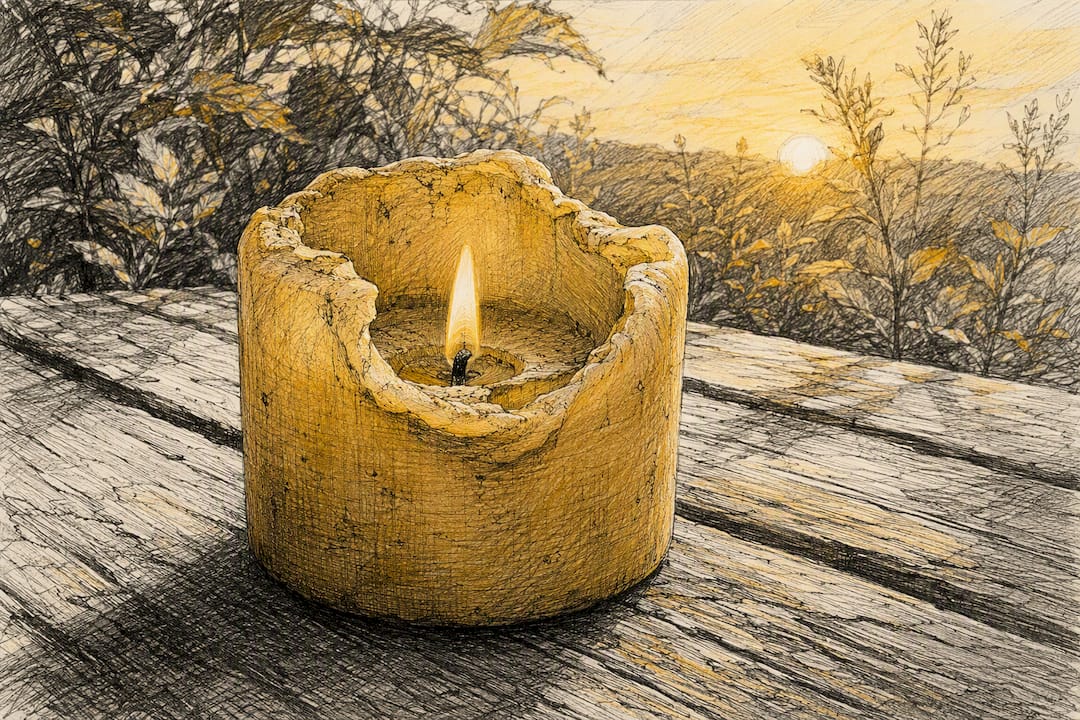
Container candles are the most prone to this because their vessel walls create a heat gradient. If the wick is undersized for the jar’s width, the center melts while the edges stay solid indefinitely, and the growing wax wall eventually can make the flame burn close to the glass itself, which raises the risk of the vessel overheating or cracking.
Pillars carry a different risk. Without a container wall for support, an oversized melt pool can cause the outer wax shell to collapse or slump sideways, sometimes tipping the flame toward the pool’s edge. Novelty and mold-shaped candles compound the problem because uneven wall thickness around decorative details creates hot spots and cold spots in the same burn, leading to unpredictable flare-ups.
The fix in every case traces back to matching wick size to shape, not fighting the shape after the fact. A wick sized for the widest part of a mold, tested through the maintenance steps covered earlier, keeps the melt pool proportional to the candle’s geometry and prevents the wax wall buildup that turns into a fire hazard. Full first-burn melt pools and consistent trim length aren’t cosmetic habits. They’re the difference between a candle that burns down evenly and one that channels heat into a single narrowing well.
What We’ve Learned Designing Beeswax Molds
Across more than 180 mold designs, certain shape patterns show up again and again. Tall, narrow molds almost always need a thinner wick than makers expect on the first try, or they tunnel within the first two burns. Wide pillar shapes are the ones most likely to need a wick swap between prototype and final production run, since scaling up the mold size changes melt-pool depth more than most makers anticipate.
Beeswax adds its own wrinkle: its higher melting point consistently rewards a slightly smaller wick than the same shape would need in paraffin. Our mold catalog reflects those adjustments, built from repeated test burns rather than a single pour.
Choosing a Mold Shape That Matches Your Burn-Time Goal
Getting a predictable burn time starts with picking a mold shape that matches what you actually want, and pairing it with the right wick from the start rather than troubleshooting a tunnel after the fact.
Latviancandles offers over 180 silicone mold designs, from tall pillars to wide votives to detailed novelty shapes, so you can pick geometry that fits your target burn time instead of guessing with whatever mold happens to be on hand. Wide, shallow molds like the big cylinder pillar mold suit makers who want a longer, steadier container-style burn, while narrower designs suit anyone chasing a faster, taper-like burn. If you’re new to matching wick size to shape, the DIY candle making starter kit pairs a mold with a wick guide so you’re not testing blind. Every mold is designed with beeswax’s higher melting point in mind, since that single material choice changes burn hours per ounce more than almost any other variable. Browse the full mold catalog and pick a shape sized to the burn time you’re actually trying to achieve.
Sources
- Analysis and measurement of candle flame shapes
- Thesis: validation and modeling of candle flame dimensions (University of Maryland repository)
- Candle Burn Time from Wax Weight Calculator|Calc
- Candle burn time explained — what actually determines how long a candle lasts
- Combustion testing before scaling a candle SKU: Part 1 — Wicks Unlimited
FAQ
What is the 3-hour rule for candles?
The 3-hour rule recommends capping a single burn session at about 3 hours to prevent the vessel from overheating and to keep the melt pool from growing beyond what the wick can manage efficiently.
What is the 8:10 rule for candles?
The 8:10 rule advises burning a candle no longer than 8 hours per session and waiting at least 10 minutes before relighting, which helps the wick and wax maintain consistent performance over the candle’s life.
Why does a candle get smaller as it burns?
The flame melts wax into a liquid pool, which the wick draws up and consumes as fuel; the solid wax shrinks in height or diameter as that fed material converts to heat, light, and vapor.
What type of candle burns the fastest?
Tapers burn fastest per unit volume because they have no vessel wall retaining heat and only a thin melt pool, while container candles typically burn most efficiently per ounce among common shapes because retained heat sustains a fuller melt pool over time.
Does mold shape affect how a beeswax candle burns compared to paraffin?
Yes. Beeswax’s higher melting point, around 144 to 147°F, means the same mold shape often needs a smaller wick in beeswax than in paraffin to avoid tunneling, which is why molds like Latviancandles’ pillar designs are built with that wax difference in mind.


