
4 Required Candle Safety Warnings Under Latvia's PTAC Rules
Every burning candle needs four warnings, whether printed on the wax itself or handed over at the point of sale: never leave it unattended, keep it away from children and pets, burn it on a heat-resistant surface, and keep it clear of drafts and flammable material. The single rule that overrides everything else is supervision. No label, snuffer, or well-designed holder replaces a person staying in the room while a flame is lit. Extinguish with a snuffer, and never carry or move a candle while the wax pool is still liquid.
TL;DR:
- Candles must be on a stable, wide, and heavy base to prevent tipping, with multi-wick designs clearly labeled for safety and extra clearance.
- Warnings should be prominently printed in legible text, with instructions to trim the wick to ¼ inch and never leave a burning candle unattended.
- Use a snuffer to extinguish candles safely, ensuring the wick tip is out and the wax has cooled before moving the candle.
- Store candles in cool, dry conditions below 30°C and pack them securely to avoid deformation during shipping.
- Small producers should run controlled burn tests for each mold and document safety instructions shipped with each batch to ensure compliance and safety.
Table of Contents
- What Must Appear on Candle Labels and Packaging
- How Do You Burn a Candle Safely?
- What Are a Producer’s Labeling and Design Duties?
- How Do You Put Out a Candle Without Getting Burned?
- Where and How Should You Store Candles?
- A Small Producer’s Practical Safety Checklist
- Why Warnings Matter More Than Decoration
- Molds and Kits Built for Stable, Safer Candles
- Sources
- FAQ
What Must Appear on Candle Labels and Packaging
Latvia’s Patērētāju tiesību aizsardzības centrs (PTAC) requires that indoor candles, or the packaging around them, carry visible and legible safety information. That means either symbols, plain text, or both. PTAC recommends a general warning symbol in yellow, paired with specific wording rather than a symbol standing alone.
The minimum wording consumers should see, on the product, the box, or a leaflet at the register, includes:
- “Never leave a burning candle unattended”
- “Keep away from children and pets”
- “Burn on a heat-resistant surface”
- “Do not burn near drafts or flammable materials”
Placement matters as much as wording. Text has to stay readable at normal handling distance, not shrunk into a corner or printed in a color that vanishes against the wax or wrapper. Small items, like votives or tea lights too tiny to carry full text, get an exception: PTAC allows the warnings to appear on an insert or at the point of sale instead of on the item itself, as long as the buyer actually receives that information before they walk out with it.
How Do You Burn a Candle Safely?
Good habits split into three phases: setup, active burning, and shutdown.
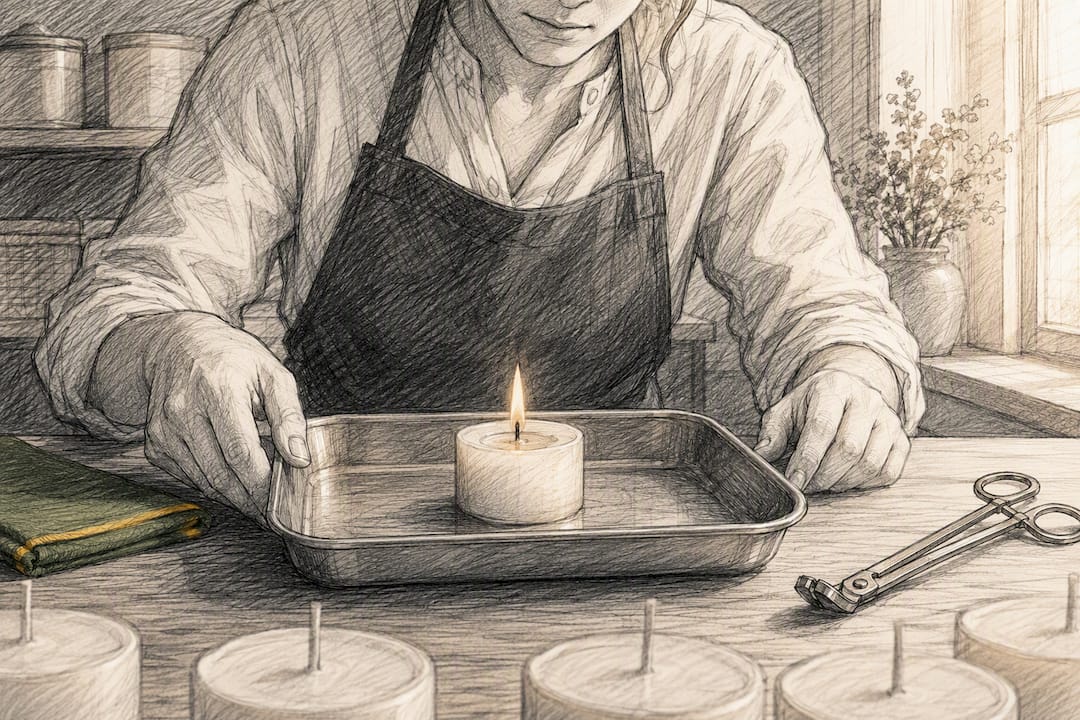
- Before lighting. Trim the wick to about ¼ inch (5–7 mm). A longer wick throws a bigger flame and drips more wax. Set the candle in a holder rated for its size, on a surface that will not scorch or tip.
- While it burns. Never walk away and leave it lit. Keep it at least a few inches from books, curtains, or anything else that catches fire, and out of drafty spots where the flame flickers unevenly and burns hot along one side. Children and pets should not be able to reach it, ever, even for a moment; for households sensitive to respiratory health, consider alternatives like an essential oil diffuser versus a scented candle to breathe easier.
- After extinguishing. Use a snuffer rather than blowing, which scatters hot wax droplets. Confirm the wick tip is fully out, not just smoking, before you leave the room. Let the wax firm up before moving the candle anywhere.
The National Candle Association backs this same sequence: trim before every burn, use stable heat-resistant holders, and stop burning once about half an inch of wax remains in the bottom.
Pro Tip: Keep a small metal snuffer next to your candle stash. Blowing out a flame feels natural, but it is also the fastest way to fling a fine spray of hot wax across a tablecloth or a hand.
What Are a Producer’s Labeling and Design Duties?
PTAC treats candle safety as a design problem first, a labeling problem second. A perfectly worded warning does nothing if the candle itself tips over on a sloped base or if the flame reaches decorative material packed too close to the wick.
Small producers and sellers carry three overlapping duties:
- Design duty: choose a base wide enough and heavy enough to stay upright through a full burn, pick containers rated for sustained heat, and keep any flame path clear of embedded decoration.
- Labeling duty: print the four mandatory warnings on the product where space allows, or prepare an insert with the same wording for point-of-sale display when it does not.
- Record duty: keep a note of what instructions shipped with which batch, so you can show, if ever asked, that buyers received the required information.
Novelty and multi-wick candles need extra attention. Multiple wicks placed too close together can produce a flame far larger than any single wick would, and some markets outright prohibit relight-style candles because of how they mislead consumers about a wick actually being out. If you sell anything with more than one wick, say so on the label and note the added clearance it needs. PTAC also runs periodic business outreach for producers who want to stay current on labeling expectations, worth checking before a new product run.
How Do You Put Out a Candle Without Getting Burned?
A snuffer is the right tool, not your breath and not a splash of water. Blowing scatters droplets of liquid wax that can land on skin or fabric; water can crack a hot glass container or send wax spitting.
- Lower the snuffer over the flame until it starves, then lift straight up.
- Never pick up or carry a candle while the top layer of wax is still liquid; a sudden tilt sends hot wax over the rim.
- Wait until the surface fully sets, usually a few minutes, then check that the wick tip shows no glow or smoke before handling.
- If wax or a wick flares unexpectedly, smother it with the snuffer or a metal lid rather than fanning it, and report any product defect to PTAC.
VUGD’s open-flame guidance reinforces the same supervision principle: most home candle incidents trace back to a flame left alone, not a faulty product. The NFPA makes a related point for households with children, recommending that matches and lighters stay stored well out of reach, not just the candles themselves.
Where and How Should You Store Candles?
Heat does more damage to unlit candles than most people expect. Wax stored above roughly 35°C softens, warps, and can pull a wick sideways before it’s ever lit; extreme cold makes wax brittle and prone to cracking around the wick base.
- Store finished candles somewhere cool, dry, and out of direct sun, ideally under 30°C.
- On display shelves, keep pieces spaced apart, seated in holders that will not slide, and away from paper decorations or fabric runners.
- For shipping, pack each candle upright with rigid support around the base so it cannot shift and deform in transit, especially for detailed molded shapes that lose definition if they soften even slightly.
A Small Producer’s Practical Safety Checklist
Warnings work better when they are short and placed where a buyer will actually read them, not buried in fine print. A pack insert can carry the four PTAC warnings plus a line like “Trim wick to ¼ inch before lighting” or “Multi-wick candle: keep 3 inches clear on all sides.”
Before a batch ships, run through this:
- Stability test: set the finished candle on a flat surface and confirm it does not rock or lean.
- Wick match: confirm wick size fits the wax volume and mold width, not just the mold’s advertised diameter.
- Trim instruction: print the ¼ inch trim guidance somewhere visible.
- Multi-wick check: burn-test any multi-wick design before selling it, since spacing that looks fine unlit can produce one oversized shared flame once lit.
Mold geometry does a lot of this work before a warning label ever gets involved. A wide, flat-bottomed pillar or cylinder shape sits more securely than a narrow tapered base, and a mold built with a defined wick channel keeps the wick centered instead of drifting toward one wall as the wax melts.
Pro Tip: Run a full burn test on one candle from every new mold batch before you list it for sale. A shape that looks stable on a shelf can behave very differently once thirty minutes of melt pool builds up around the base.
Why Warnings Matter More Than Decoration
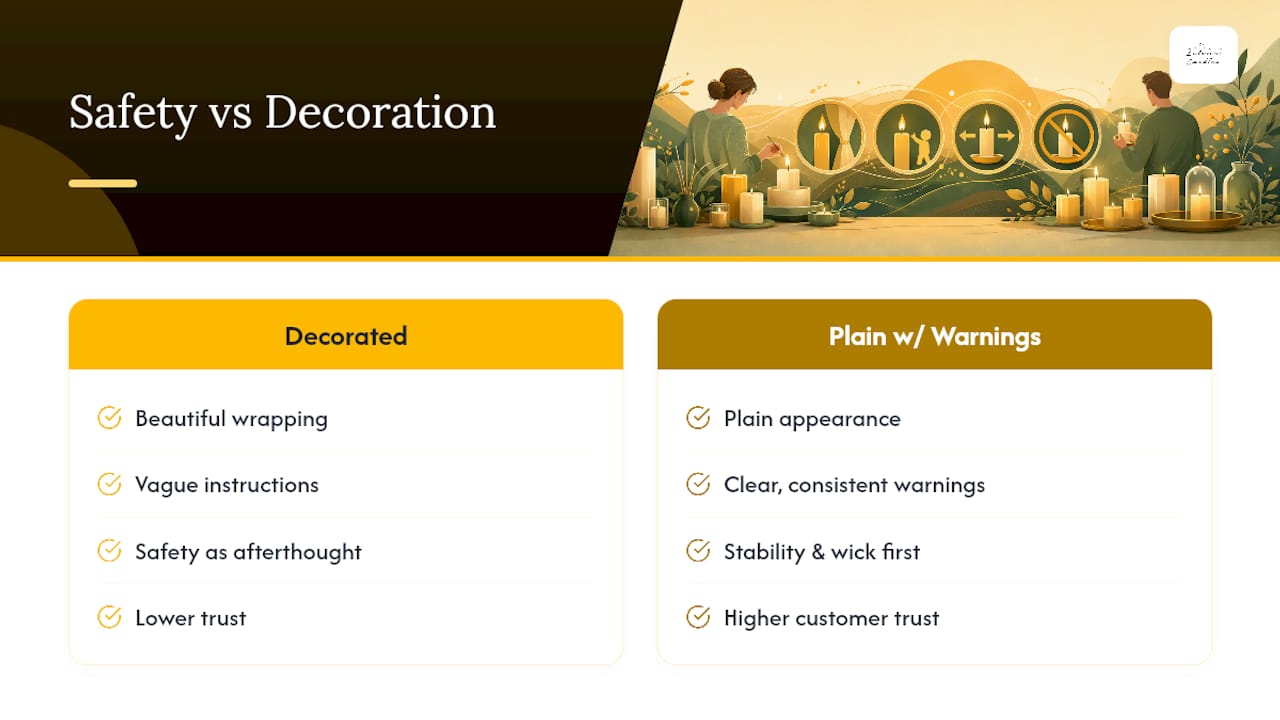
A producer’s real obligation is not decorative, it’s mechanical: reduce the chance that a normal, foreseeable use of the candle causes harm. That means stability and wick placement come before any embellishment on the label.
Clear, consistent warnings build the kind of trust that keeps customers coming back, because buyers notice when a small maker treats safety as a given rather than an afterthought. Given the choice between a beautifully wrapped candle with vague instructions and a plain one with the four required warnings printed clearly, choose the plain one every time. Decoration can wait. Legibility cannot.
— Marks
Molds and Kits Built for Stable, Safer Candles
Latviancandles gives small makers a shortcut past the trial-and-error most people go through to find a base that won’t tip or pool unevenly. Every mold in the 180-plus design catalog is built around wide, flat-bottomed geometry and a centered wick channel, so the stability test in your checklist starts easier instead of harder.

Appropriate wick holders and pre-shaped bases reduce the two most common problems producers run into: candles that lean or tip mid-burn, and molten wax pooling unevenly around an off-center wick. If you’re setting up a new product line or just getting past your first few burn tests, the DIY candle making starter kit bundles molds and wick holders sized to work together, so you’re not guessing at compatibility. Browse the starter pack and pick a shape built for a stable base from the first pour.
Sources
For the regulatory basics behind this guide, consult PTAC’s product safety guidance and VUGD’s open-flame recommendations. The National Candle Association and NFPA publish additional practical safety material worth bookmarking.
- Patērētāju tiesību aizsardzības centrs (PTAC) — product safety
- Valsts ugunsdzēsības un glābšanas dienests (VUGD) — candle/open flame use
- National Candle Association — Candle Safety Tips
- NFPA — Safety with candles
FAQ
What Warnings Are Legally Required on a Candle?
At minimum: never leave it unattended, keep it away from children and pets, burn it on a heat-resistant surface, and keep it clear of drafts and flammable material, per PTAC guidance.
Can a Small Candle Skip the Warning Label?
Not entirely. If the item is too small for full text, the same warnings must reach the buyer through packaging or a point-of-sale insert instead.
How Short Should a Wick Be Trimmed Before Lighting?
About ¼ inch (5 to 7 millimeters), which keeps the flame a manageable size and limits dripping, according to National Candle Association guidance.
Is It Safe to Blow Out a Candle Instead of Using a Snuffer?
A snuffer is the safer choice because it starves the flame without scattering hot wax droplets the way blowing does.
Do Mold Shape and Base Width Affect Fire Risk?
Yes. A wide, flat base and a centered wick channel, like those in Latviancandles’s pillar and cylinder molds, reduce the chance of tipping or an uneven melt pool during a burn.


