
What Beeswax Candles Really Cost to Make Per Unit
A hand-poured beeswax tea light typically runs $1.20 to $2.50 in raw cost. A taper lands between $2.00 and $4.50. A pillar candle, depending on size and mold, costs $4.00 to $9.00 to produce. Beeswax itself drives most of that spread, since it’s priced well above soy or paraffin, with 8-ounce equivalents running $7.50 to $10.00 in wax alone before you add anything else.
The formula behind every one of those numbers is the same:
Cost per candle = materials + labor + overhead + tooling amortization
Get your own number by doing three things this week:
- Weigh the exact wax used in one candle on a kitchen scale.
- Time yourself pouring a full batch, start to cleanup.
- Divide what you paid for your mold by how many pours you expect to get from it.
Key Takeaways
Beeswax candle cost comes down to four line items added together, and wax price plus mold durability drive most of the swing between a $1.50 tea light and a $9.00 pillar.
| Point | Details |
|---|---|
| Use the four-part formula | Materials plus labor plus overhead plus tooling amortization equals your true per-candle cost. |
| Wax dominates the budget | Beeswax alone can account for $0.40 to $3.00+ per candle depending on size, so price shop by the kilogram. |
| Amortize molds by pour count | Divide mold price by expected uses; a durable silicone mold can bring this below $0.20 per candle. |
| Skip fragrance when possible | Beeswax’s natural aroma and low fragrance-load ceiling make unscented a legitimate zero-cost choice. |
| Price for margin, not just materials | A 3 to 4x markup on total COGS is the standard direct-to-consumer benchmark once you sell. |
Table of Contents
- Bišu Vaska Sveču Izmaksas: Breaking Down the Real Cost Drivers
- Amortizing Molds and Tools Into Your Per-Candle Price
- Two Worked Examples: Tea Light vs. Artisan Pillar
- Cutting Per-Candle Cost Without Cutting Corners
- What Latvian Candles Adds to the Tooling Equation
- Where to Verify Your Own Numbers
- Why Most Cost Guides Get This Wrong
- Sources
- FAQ
Bišu Vaska Sveču Izmaksas: Breaking Down the Real Cost Drivers
“Bišu vaska sveču izmaksas” is Latvian for beeswax candle costs, and the phrase covers exactly what most candle makers actually want to know: what goes into cost of goods sold (COGS), and how each input scales with candle size. Skip the retail-price comparisons you’ll find elsewhere. What matters here is your own production math.
Beeswax pricing works by weight, so the conversion is simple: take the price per kilogram (or pound), convert to price per gram, then multiply by the grams your candle actually uses.
- Beeswax cost. If beeswax runs roughly $16 to $22 per kilogram ($0.016 to $0.022 per gram), a 20-gram tea light costs $0.32 to $0.44 in wax. A 150-gram pillar costs $2.40 to $3.30. These numbers move with your supplier and whether you’re buying pellets, blocks, or filtered sheets.
- Wick cost. Cotton wicks generally run $0.05 to $0.25 each depending on braid and length; wooden wicks tend to sit at $0.15 to $0.40 each because of the crackle-wick trend. Most tea lights need one wick; pillars over 3 inches wide often need two or three for an even burn pool.
- Fragrance, usually skipped. Beeswax carries a naturally low fragrance load ceiling of about 3 to 6 percent, well under what soy or paraffin can absorb. Many makers sell beeswax candles unscented specifically to preserve the honey aroma, which means fragrance oil is often a $0 line item. Add it, and expect $0.10 to $0.60 per candle depending on oil quality and load percentage.
- Packaging and labels. A basic label costs pennies. A branded box, tissue wrap, or a printed care card adds $0.50 to $2.00 per unit. Skip this line for candles you keep or gift, but count it the moment you plan to sell.
Quick math check: A 20-gram tea light with a $0.15 wick and no fragrance runs roughly $0.47 to $0.59 in materials alone, before labor, overhead, or mold amortization enter the picture.
Amortizing Molds and Tools Into Your Per-Candle Price
Split your equipment into two buckets. Consumables get used up: wicks, wick stickers, wax paper, the fragrance oil itself. Capital equipment gets reused across dozens or hundreds of pours: your wax melter, digital thermometer, pouring pitcher, and silicone molds.
The amortization math is one division problem: mold cost ÷ expected number of uses = per-candle mold cost. A $28 silicone mold rated for 200+ pours before wear sets in costs you $0.14 per candle in tooling. Compare that to a cheap aluminum mold that warps after 15 uses, and the amortized cost jumps past $1.80 per candle even though the sticker price looked similar upfront.
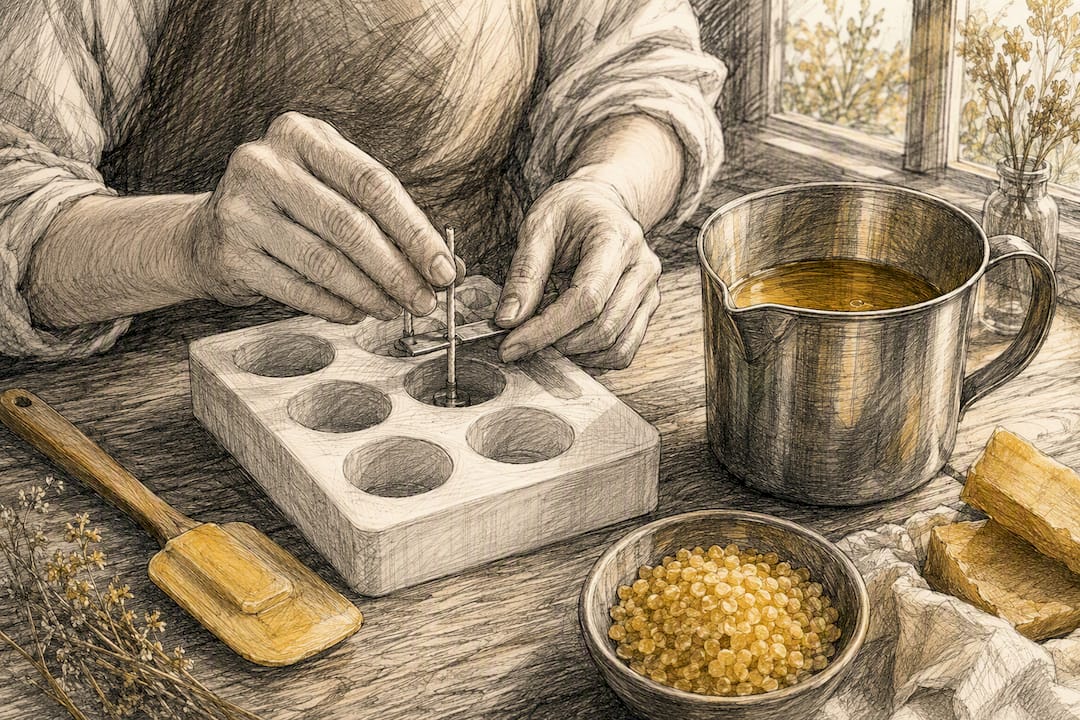
This is where reusable silicone molds earn their keep. Silicone flexes for easy release without cracking, resists the thermal stress of repeated hot pours, and typically outlasts metal or plastic alternatives by a wide margin, spreading your tooling cost thin across a large batch run.
Minimal starter toolkit checklist:
- A double boiler or dedicated wax melter
- A digital thermometer accurate to 5°F
- At least one durable, reusable silicone mold
- A pouring pitcher with a spout
- Wick centering tools or clips
Pro Tip: Buy one high-quality mold before you buy five cheap ones. A single mold that survives 300 pours beats five that fail at 40, even at a higher sticker price.
Two Worked Examples: Tea Light vs. Artisan Pillar
Example A: Hobbyist beeswax tea light
- Wax: 20 grams at $0.02/gram = $0.40
- Wick: 1 cotton wick = $0.12
- Mold amortization: $28 mold ÷ 200 uses = $0.14
- Labor: 3 minutes at a $15/hour rate ÷ 60 = $0.75
- Overhead (utilities, wear, small tools): $0.10
- Packaging: none (unlabeled, personal batch)
- Total COGS: $1.51 per tea light
Example B: Small-batch artisan pillar
- Wax: 150 grams at $0.02/gram = $3.00
- Wicks: 2 wooden wicks at $0.25 each = $0.50
- Mold amortization: $45 pillar mold ÷ 150 uses = $0.30
- Labor: 8 minutes at $18/hour ÷ 60 = $2.40
- Overhead allocation (following the standard method of monthly overhead ÷ production volume): $0.35
- Packaging (branded label and tissue): $1.00
- Total COGS: $7.55 per pillar
Run a sensitivity check before you commit to a price. A 20 percent jump in wax price adds roughly $0.08 to the tea light and $0.60 to the pillar. Doubling your batch size from 20 to 40 candles typically cuts the labor-per-candle figure nearly in half, since setup and cleanup time gets spread across more units without growing proportionally.
Cutting Per-Candle Cost Without Cutting Corners
Raw wax typically makes up the largest slice of your production expense, often 65 to 75 percent of total operating costs in candle-making generally. That single fact should guide where you focus first.
- Buy beeswax in 5 to 10 kilogram blocks instead of 500-gram bags; bulk pricing often drops the per-gram rate by 15 to 30 percent.
- Pour in batches of 12 or more using a shared melt, and set a timer instead of eyeballing cooling stages, which cuts labor minutes per candle significantly.
- Care for your molds properly (avoid overheating wax past 185°F when pouring into silicone) to extend usable life and keep amortization low; a melting guide walks through safe temperature ranges.
- Skip fragrance and premium packaging on practical or gift-overflow batches; save the branded box for candles you’re actually selling.
- Pool a wax order with two or three other local makers to hit bulk pricing tiers none of you could reach alone.
Pro Tip: Track your mold’s pour count on a sticky note taped to your workbench. Most makers underestimate how many uses they’ve gotten, which throws off the amortization math.
What Latvian Candles Adds to the Tooling Equation
Latvian Candles has produced over 180 artisan silicone mold designs since the brand started in 2015, covering bee cells, tapers, tea lights, and pillar shapes built specifically for beeswax pours. Durable silicone construction means a single mold spreads its cost across hundreds of uses instead of dozens.
- A starter kit bundles molds and basic tools into one purchase, cutting the trial-and-error spending that usually accompanies a first attempt.
- Bee-cell mold designs, like the Bees on Cells silicone mold, let you produce a distinctive shape without paying custom-tooling prices.
- Reusable molds hold their shape across repeated hot pours, which keeps your per-candle tooling line closer to $0.10 to $0.20 than the $1.00+ you’d see from a mold that degrades fast.
A mold that survives 300 pours instead of 30 changes your entire cost structure, not just your tooling line. It’s the difference between amortization being a rounding error and amortization eating your margin.
Pro Tip: If you’re not sure how many pours a new mold will survive, check care instructions first. Mold-care habits, more than material quality alone, determine how many uses you actually get.
Where to Verify Your Own Numbers
- Candle Pricing Calculator (Tools for Makers) for running your own materials-plus-margin math.
- CyCandle’s cost-per-candle guide for the overhead-allocation formula used above.
- Latvian Candles’ melting guide for temperature control that reduces wasted wax.
Plug your own supplier prices into a calculator before finalizing any per-candle number. Local pricing and batch habits shift these figures more than any generic table can predict.
Why Most Cost Guides Get This Wrong
Most candle-cost content stops at materials, and that’s the single biggest error in the hobby. Wax and wick add up fast, sure, but the number that actually determines whether you’re profitable, or just breaking even on your own hobby time, is labor per candle. A maker who takes 12 minutes to pour a tea light that a more practiced hand pours in 3 minutes is paying four times the labor cost, and no materials discount fixes that gap.
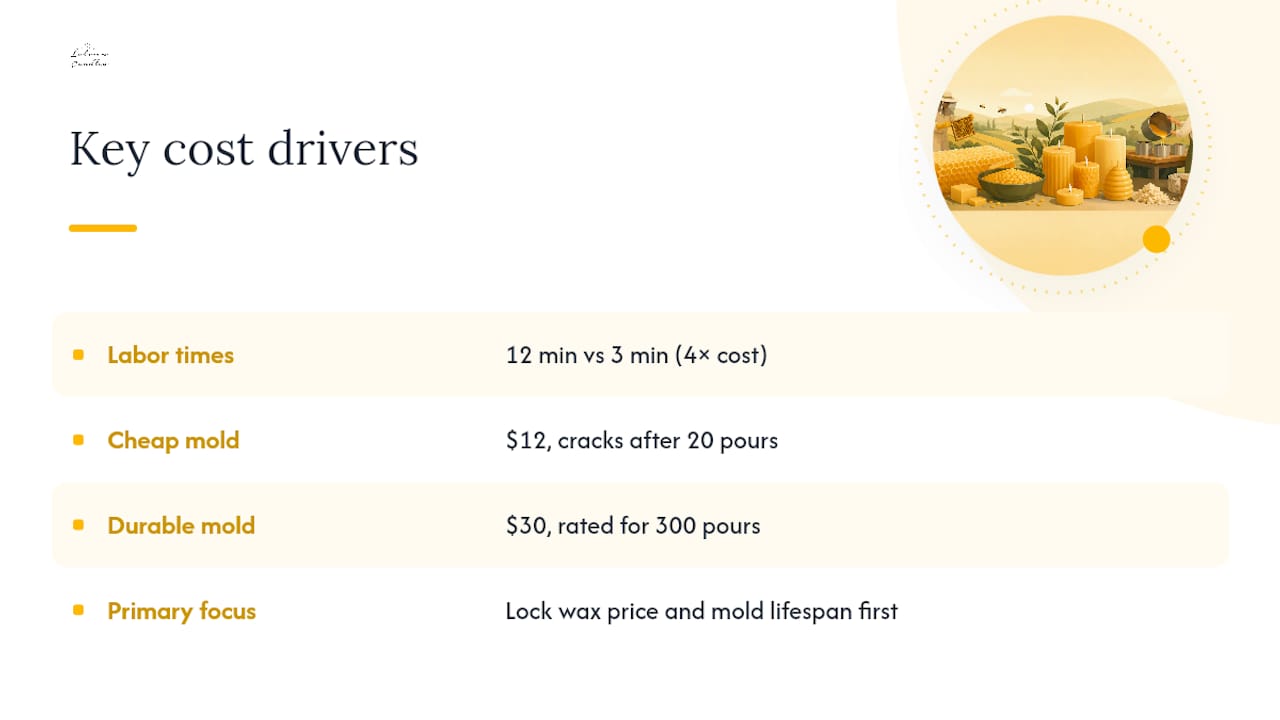
The other blind spot is tooling. Cheap molds feel like savings until you calculate cost per use rather than cost per purchase. A $12 mold that cracks after 20 pours is more expensive, per candle, than a $30 mold rated for 300. That math only works in your favor if you actually track pour counts, which almost nobody does.
Start with your wax price and your mold’s real lifespan. Everything else, fragrance, packaging, labels, is optional polish you add once those two numbers are locked down.
— Marks
Sources
- Candle Pricing Calculator | Tools for Makers
- Candle Maker Cost Math | Ardent Seller
- Calculating Cost Per Candle: A Simple Guide | CyCandle
FAQ
How much does it cost to make a beeswax candle?
A beeswax tea light typically costs $1.20 to $2.50 to produce, a taper $2.00 to $4.50, and a pillar $4.00 to $9.00, depending on wax price, wick type, and mold amortization.
Why is beeswax more expensive than soy or paraffin?
Beeswax requires bees to produce it naturally rather than being refined from petroleum or soybean oil, and supply constraints keep per-kilogram pricing well above soy or paraffin.
Do beeswax candles need fragrance oil?
No. Beeswax has a naturally lower fragrance-load ceiling of about 3 to 6 percent, and many makers sell it unscented to preserve its natural honey scent, which also removes a recurring cost.
How do I calculate the cost of a reusable silicone mold per candle?
Divide the mold’s purchase price by the number of pours you realistically expect before it wears out; a $28 mold good for 200 pours costs about $0.14 per candle in tooling.
What’s a reasonable markup for selling handmade beeswax candles?
Most maker guides recommend pricing at 3 to 4 times your total COGS for direct-to-consumer sales, and around 2 times COGS for wholesale accounts.


