
Avoid Mold Tears: Silicone Hardness 15–35 Shore A for Beeswax Molds
For most reusable candle and craft molds, recommended Shore A hardness ranges vary depending on flexibility and detail needs, with softer ranges for detailed pieces and firmer ranges for structural molds. The Shore A durometer scale measures resistance to indentation, and matching it to your mold’s geometry balances easy demolding against tear resistance, which is the trade-off that determines how many pours a mold actually survives.
TL;DR:
- Softer silicone (15 to 25 Shore A) is ideal for detailed undercuts like bee-cell honeycombs, while firmer (40 to 60 Shore A) suits resin and heavier materials.
- Shore A readings vary with wall thickness, temperature, and testing method; therefore, actual performance may differ from datasheet specifications.
- Reinforcing molds with rigid outer shells can extend lifespan more effectively than increasing silicone hardness alone, especially for high-cycle applications.
- Testing a small cast in your specific mold geometry and requesting full datasheets from suppliers helps prevent tearing or demolding issues.
- Silicone molded for beeswax should match the design’s complexity, with softer grades for fine detail and harder for simpler shapes, to optimize durability and release.
Table of Contents
- What Does Silicone Mold Hardness (Shore A) Actually Measure?
- How Hardness Changes Flexibility, Detail, and Demolding
- Recommended Shore A Ranges by Mold Application
- How to Choose the Right Hardness for Your Mold
- Testing and Measuring Silicone Hardness Before You Buy
- What Shortens Mold Life and How to Extend It
- Practitioner Notes for Beeswax Candle Molds
- The Honest Take on Hardness Charts
- Silicone Molds Built for Beeswax, Matched to the Right Hardness
- Sources
- FAQ
What Does Silicone Mold Hardness (Shore A) Actually Measure?
Shore A hardness measures how much a material resists being indented by a spring-loaded pin under a set force. A durometer presses that pin into the silicone and reads the depression on a 0 to 100 scale. Zero would be like water; 100 is closer to a hard plastic like a shopping cart wheel. Silicone used for molds usually falls somewhere between 5A and 80A, with most hobby and small-production molds sitting in the 10 to 60 range.
The number on a spec sheet is not an absolute constant. It shifts with sample thickness, temperature, and how long the reading is held before you record it. A 6mm test slab and a 2mm mold wall of the “same” silicone can give you noticeably different feel, even though the chemistry is identical. This matters more than most buying guides admit: a supplier’s stated 30A does not guarantee your thin-walled taper mold will behave like a lab sample.
A few practical points worth knowing before you compare silicone by hardness number alone:
- Shore A readings are typically taken a few seconds after the pin contacts the material, since silicone can show slight stress relaxation that lowers the reading over time.
- Manufacturers test on standardized slabs, so a mold with thin walls, sharp internal corners, or foam-backed sections will feel softer or stiffer than the datasheet number suggests.
- Two silicones can share the same Shore A rating and still perform very differently, because tear strength, elongation, and rebound are separate properties not captured by hardness alone.
- Room temperature during testing affects the reading, and silicone that feels firm at 20°C can feel noticeably softer at 30°C in a warm workshop.
None of this makes Shore A useless. It is still the fastest, most universal shorthand for comparing one silicone against another. It just works best as a starting filter, not the entire decision.
How Hardness Changes Flexibility, Detail, and Demolding
Every hardness choice is a trade-off between two things pulling in opposite directions: how easily the mold releases the cast piece, and how well it survives the stress of that release. Softer silicone flexes and peels away from undercuts with almost no effort, but that same softness tears more readily under repeated stretching. Firmer silicone holds its shape and resists tearing, but it fights you on release, especially around sharp internal details.
Geometry decides which side of that trade-off matters more. A mold with deep undercuts, like a raised bee-cell pattern or a sculpted taper with decorative ridges, needs enough stretch to peel back over the widest point without the cavity walls cracking. A simple straight-sided pillar mold with no undercuts can run firmer, since there is nothing to flex around during release. Wall thickness plays a role too: a mold wall under 3mm needs somewhat softer silicone to flex without splitting, while a thicker wall in the 5 to 8mm range can run firmer and still demold cleanly.
Three craft examples show how this plays out in practice:
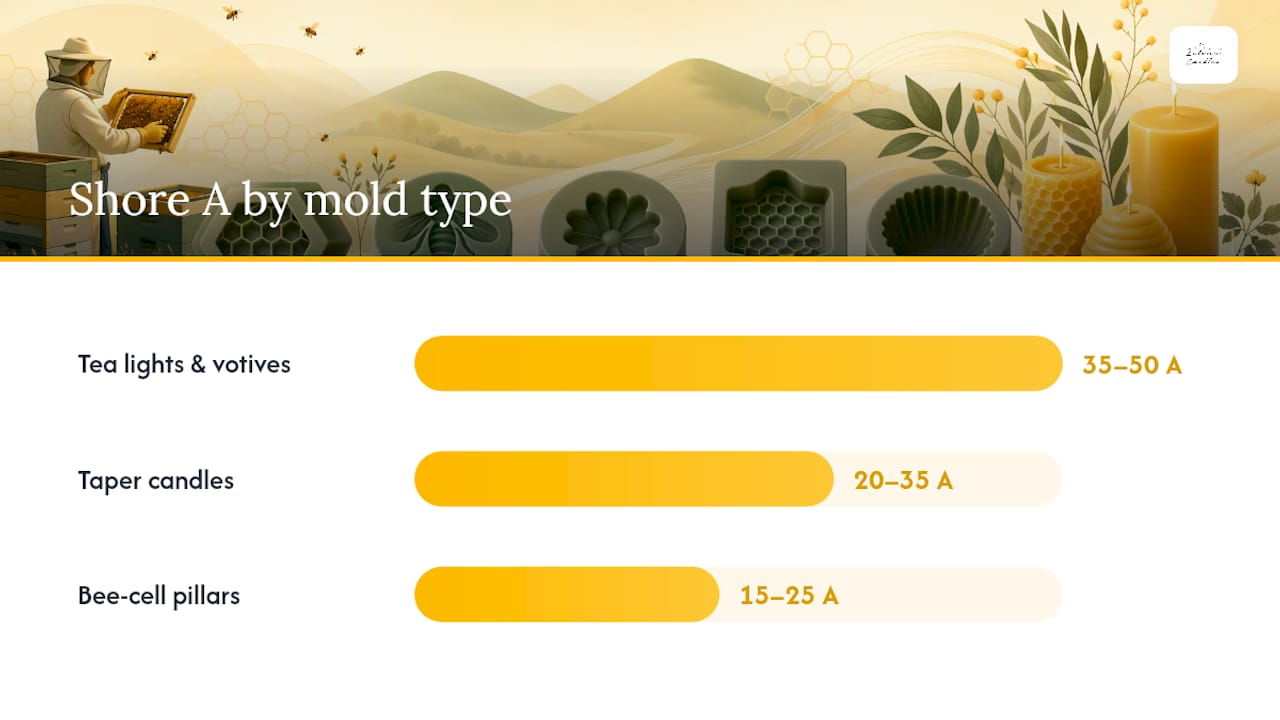
- Tea lights and simple votives have shallow, straight-walled cavities with no undercuts, so 35 to 50 Shore A gives you dimensional stability without demolding trouble.
- Taper candles are long and narrow, which makes them prone to stretching or bending during removal, so 20 to 35 Shore A gives enough give to slide the taper out without cracking the mold wall.
- Bee-cell honeycomb pillars have dozens of small raised hexagonal undercuts packed close together, and those need the flexibility of 15 to 25 Shore A, because a firmer silicone will tear at the base of each cell rather than release cleanly.
Pro Tip: If you’re unsure which way to lean, test with the softer option first. A mold that’s slightly too soft can often be reinforced with a rigid outer shell or plaster jacket, but a mold that’s too firm to release detail will just keep tearing, no matter how careful you are.
Draft angles help every hardness level. Even a couple of degrees of taper on vertical walls reduces the suction and friction that cause tearing during release, letting you use a firmer, longer-lasting silicone than the geometry alone would suggest.
Recommended Shore A Ranges by Mold Application
Hardness recommendations shift depending on what you are casting, not just what shape you are casting it into. A resin caster and a candle maker pouring into visually similar molds need very different silicone properties, because the materials interact with the mold wall in different ways.
- Beeswax and soy candles: 15 to 35 Shore A works for most designs, since wax shrinks slightly on cooling and a flexible mold accommodates that without cracking; fine-detail pieces like bee cells lean toward the softer end of that band.
- Cold-process soap: 30 to 45 Shore A handles soap’s mild chemistry well and holds crisp edges on embossed or textured bar designs.
- Chocolate and other food casting: hardness matters less than certification here. Use a food-grade platinum silicone rated for food contact, typically in the 20 to 40 Shore A range, and confirm the supplier’s certification rather than relying on hardness alone.
- Resin and epoxy casting: 40 to 60 Shore A or higher is common, because uncured resin generates heat and some formulations attack softer silicones over repeated cycles; high-tear, firmer compounds last longer under that chemical load.
- Concrete and plaster: 45 to 65 Shore A tends to hold up best, since these materials are abrasive and heavy, and a mold needs enough rigidity to keep its shape under the weight of a wet pour.
The food-grade point deserves emphasis on its own. A silicone rated 20A that is not certified for food contact is not a safe chocolate mold no matter how well it performs mechanically. Certification and hardness are separate specifications, and buyers regularly confuse the two.
Resin casters should also watch for chemical attack over time, not just on the first pour. A tin-cure silicone that handles resin fine for ten cycles can start degrading by cycle thirty, which is one more reason cure chemistry matters as much as the hardness number itself.
How to Choose the Right Hardness for Your Mold
Selecting hardness is a sequence of decisions, not a single choice. Working through them in order avoids the common mistake of picking a Shore A number first and then discovering it does not suit the geometry or the casting material.
- Map the geometry. Count the undercuts, note the deepest one, and measure the intended wall thickness. More undercuts and thinner walls both push you toward softer silicone.
- Identify the casting material. Wax, soap, resin, and plaster each interact differently with silicone, and the application ranges above should set your starting band.
- Estimate cycle volume. A mold you expect to use twice needs less durability than one you plan to pour hundreds of times, which affects both hardness and cure system choice.
- Decide on cure chemistry. Platinum-cure (addition-cure) silicones deliver better long-term dimensional stability and higher tear strength than tin-cure options, making them the better pick for anything beyond occasional hobby use.
- Confirm food-safety needs. If the mold touches anything edible, require documented food-contact certification, not just a verbal assurance.
- Ask the supplier for a full datasheet, not just a hardness number. A proper spec sheet lists Shore A tolerance, density, working time, and cure schedule together, the way a certified food-grade silicone datasheet typically does, with fields like Shore A 30 ±2, density 1.1 g/cm³, working time of 40 to 50 minutes, and a cure time of 7 to 9 hours at 25°C.
Pro Tip: Before committing to a bulk mold order, ask the supplier for a small test sample cast in the exact silicone you’re considering. A five-minute demold test on your actual design tells you more than any spec sheet, since real geometry always behaves a little differently than a flat test slab.
Reinforcement often solves problems that hardness alone cannot. Adding a rigid backing or reinforcing thin mold walls frequently extends usable life more cost-effectively than jumping to a firmer, more expensive silicone grade. A softer, more flexible mold with a supportive outer shell can outperform a harder standalone mold on both detail reproduction and lifespan.
Testing and Measuring Silicone Hardness Before You Buy
A handheld Shore A durometer is the standard tool, and it is worth owning one if you order silicone in any volume. Press the foot flat against a smooth, flat section of cured silicone at least 6mm thick, apply firm even pressure, and read the dial within a few seconds of full contact. Take three readings at different spots and average them, since silicone is never perfectly uniform straight out of the mixing cup.
Beyond the durometer reading, a few quick checks catch problems before they become expensive mistakes:
- Run a real test cast, not just a hardness check, using your actual mold design rather than a flat sample, since undercuts and thin sections behave differently than lab slabs.
- Measure demold force qualitatively by timing how long it takes to release the piece cleanly. If you’re fighting the mold on the very first pour, it will only get worse as the silicone ages.
- Ask suppliers for temperature ratings in writing, especially if you pour hot wax or work near a heat source, since silicone that is firm at room temperature can soften noticeably above 60°C.
- Request chemical-compatibility notes for your specific casting material, particularly with resins, since some catalysts and colorants attack silicone surfaces over repeated exposure.
Skipping these checks is how hobbyists end up with a beautiful mold that tears on the fourth pour instead of the fortieth.
What Shortens Mold Life and How to Extend It
Three forces destroy silicone molds: chemical attack, thermal fatigue, and mechanical tearing. Aggressive resins, repeated high-heat exposure, and rough demolding technique are the most common culprits, and most mold failures trace back to one of these three rather than simple old age.
Cure chemistry changes how much of that stress a mold can absorb. Platinum-cure silicones generally deliver far higher usable cycle counts and negligible shrinkage compared with tin-cure alternatives, which is why serious production work almost always favors platinum systems despite the higher upfront cost. Tin-cure molds shrink slightly over months and lose dimensional accuracy faster, though they remain a reasonable economical choice for short-run or single-use projects.
Good habits stretch a mold’s working life considerably:
- Clean molds with mild soap and water rather than harsh solvents, which can degrade the silicone surface over time.
- Use a light release agent consistently rather than relying on the mold’s natural non-stick surface, which wears down with repeated pulls.
- Store molds flat or with a support casting inside them, since distorted storage shapes can set permanently if left folded for weeks.
- Reinforce thin walls with a rigid outer jacket for molds you expect to use heavily.
- Watch for small surface tears near undercuts, since a minor crack there tends to spread quickly with continued use.
Realistic cycle counts vary enormously by material and use. Hobby and workshop molds can last anywhere from dozens to thousands of pours depending on the silicone grade, the casting material, and how carefully the mold is handled. That range is wide on purpose; a soft detail mold pouring aggressive resin will wear out far faster than a firm general-purpose mold pouring cooled wax. Watch for surface tackiness, visible cracking near cavity edges, or a demold that suddenly requires much more force than it used to. Those are your signals to retire the mold rather than push it for one more batch.
Practitioner Notes for Beeswax Candle Molds
Beeswax behaves differently than paraffin or soy wax, and that changes which Shore A ranges actually work best in practice. Beeswax shrinks a bit more on cooling and holds heat longer after unmolding, so a mold needs enough flexibility to accommodate that shrinkage without stress-cracking at the corners.
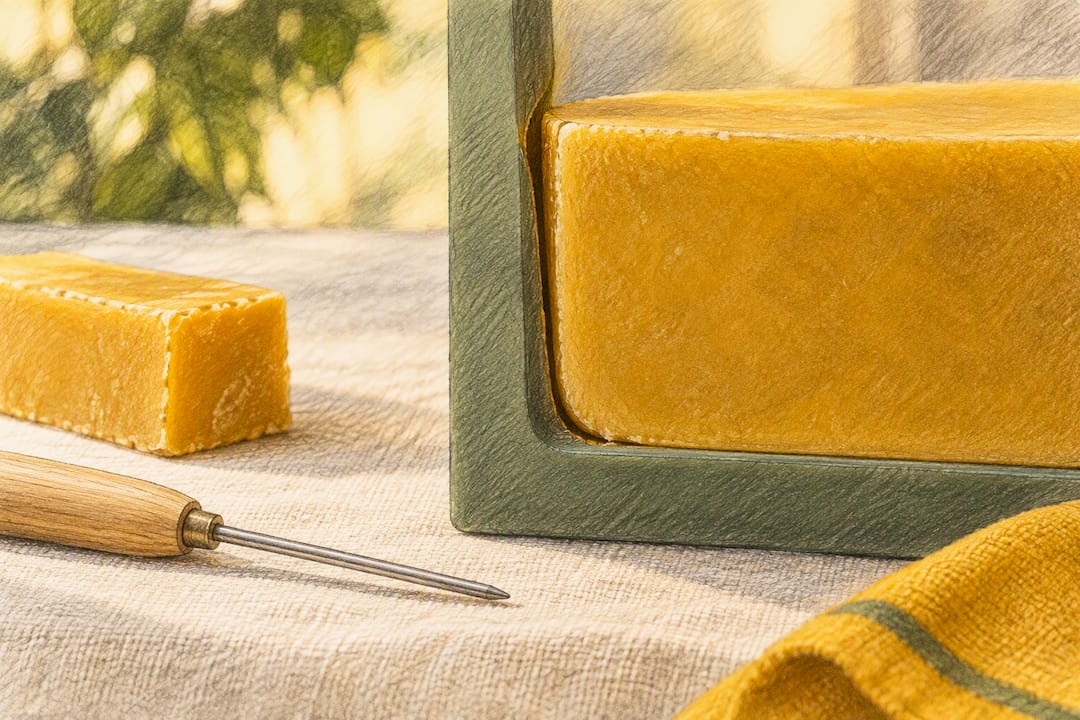
For tapers, a softer 20 to 30 Shore A range makes it far easier to slide a long, narrow candle out without bending or snapping it, especially on designs longer than 20cm. Votive and tea light molds can run slightly firmer, around 35 to 45 Shore A, since their shorter, wider shape does not need the same stretch during release. Bee-cell pillar molds, with their dense clusters of raised hexagonal detail, need the flexibility of 15 to 25 Shore A, because firmer silicone consistently tears at the narrow base of each cell during removal.
A few workshop habits make a real difference in mold longevity:
- Let cast beeswax candles cool fully to room temperature before attempting to demold, since pulling a still-warm taper is the single most common cause of stretched or torn mold walls.
- Wipe cooled molds with a soft cloth rather than washing after every single pour, saving actual soap-and-water cleaning for periodic deep cleans.
- Store bee-cell and detail molds flat, ideally with a light dusting of cornstarch on the cavity surface to prevent the fine hexagonal ridges from sticking to themselves over time.
- Rotate between two or three molds of the same design if you are running a production batch, giving each mold recovery time between pours rather than demolding it warm, back to back, all day.
The Honest Take on Hardness Charts
Most hardness charts treat Shore A like a single dial you can set and forget, and that oversimplifies a decision that actually depends on three interacting variables: geometry, casting material, and expected cycle count. A 30A mold is not automatically the “safe middle choice” for every project. It is the right choice for some geometries and the wrong one for others, and picking it just because it sits in the middle of a chart is how people end up disappointed with molds that either tear too fast or refuse to release cleanly.
The trade-off that actually matters, and the one most buying guides gloss over, is that reinforcement and design choices often solve problems that a harder silicone cannot fix on its own. A well-designed draft angle or a supportive backing shell can let you use a softer, more detail-friendly silicone and still get a long service life out of it. Chasing a higher Shore A number as the default fix for a short-lived mold usually treats the wrong symptom.
If you take one action from this: test a small sample cast in your actual mold geometry before committing to a bulk order, and ask your supplier for the full datasheet, including tear strength and cure schedule, not just the Shore A number on its own.
— Marks
Silicone Molds Built for Beeswax, Matched to the Right Hardness
Some silicone molds are designed specifically for beeswax, with hardness, wall thickness, and draft angles matched to how beeswax shrinks and releases.

The bee-cell honeycomb pillars use the softer, flexible silicone this article recommends for dense undercut detail, while the taper collection and tea light molds are built at hardness levels suited to their simpler geometry, so you are not guessing which Shore A band fits your project. The full catalog of silicone candle molds includes matching wick holders, and if none of the 180-plus existing designs fit your idea, Latviancandles also takes custom candle mold requests built around your specific shape and pour volume. Browse the collections page to compare designs, or start with a starter kit if you’re pouring your first batch this month.
Sources
For a deeper technical grounding beyond this guide, a few resources stand out. The CMAI hardness selection guide breaks down Shore A ranges by industrial application. Acme Silicone’s mold lifespan engineering notes explain platinum versus tin-cure durability in more depth than most consumer guides attempt. JC Proto’s breakdown of mold failure factors is useful if you’re troubleshooting a mold that is failing faster than expected. For a vendor-neutral primer on silicone material properties generally, Plastnet’s technical overview covers the underlying chemistry without a sales angle.
- Vadlīnijas pareizas silikona cietības izvēlei - CMAI
- Silicone Mold Life: Factors That Destroy Your Tooling
- Engineering Durability: Maximizing Silicone Mold Lifespan for Production - Acme Silicone Limited
- Silfood food-grade platinum silicone product page
FAQ
What Shore A Hardness Is Best for Candle Molds?
Most beeswax candle molds work best between 15 and 35 Shore A, with softer values around 15 to 25A for detailed bee-cell designs and slightly firmer 30 to 45A for simple votives and tea lights. The right number depends on how many undercuts your design has and how deep they run.
How Do I Test Silicone Hardness Without a Durometer?
Press your thumbnail firmly into a flat section of cured silicone; a deep, easy indentation suggests a soft compound in the 10 to 25A range, while resistance with minimal marking suggests something firmer, above 40A. This is only a rough estimate. A handheld Shore A durometer gives an actual number and is worth the investment if you buy silicone regularly.
Does Platinum-Cure Silicone Last Longer Than Tin-Cure?
Yes. Platinum-cure silicones generally offer far higher usable cycle life and negligible shrinkage compared with tin-cure options, making them the better choice for molds you plan to use repeatedly over months or years. Tin-cure remains a reasonable, lower-cost option for short-run or single-use projects.
What Hardness Should I Use for Resin Casting?
Resin casting generally calls for firmer silicone, typically 40 to 60 Shore A or higher, since uncured resin generates heat and some formulations chemically attack softer compounds over repeated pours. Choosing a high-tear, platinum-cure formulation extends mold life significantly when casting resin regularly.
Does Latviancandles Sell Molds With Different Hardness Levels?
Latviancandles designs its silicone molds specifically for beeswax, with hardness matched to each design’s geometry, softer for detailed bee-cell patterns and firmer for simple shapes like tea lights and classic pillars. Current pricing for individual mold designs and custom orders is available directly on the Latviancandles site.


