
Beeswax Volumes for Mold Makers: Water Test, 5–10% Reserve, Latvia
To find the vaska daudzums veidnei, or wax amount for mold, multiply the cavity volume in milliliters by 0.96 g/mL (beeswax density), then multiply by your fill percentage, typically 85 to 95%, add 5 to 10% extra reserve wax for a top-up pour. A 100 mL mold at 90% fill needs about 86 grams, plus roughly 5 grams in reserve to fix sinkage.
TL;DR:
- A 100 mL mold filled to 90% typically requires about 86 grams of beeswax, plus an extra 5 grams for top-up purposes.
- Using a water displacement test provides the most accurate volume measurement for irregular molds, ensuring precise wax calculation.
- Beeswax contracts as it cools, so plan to melt an additional 5 to 10% of wax to compensate for sinkage and cratering.
- Precision scales are essential, with a 0.1 gram accuracy recommended for small batches under 20 grams to avoid significant rounding errors.
- Wall thickness and mold design often reduce usable volume compared to the stamped product size, especially for textured or embossed molds.
Table of Contents
- How Do You Calculate Wax Amount for a Mold?
- Measuring Irregular Molds With a Water Test
- Why Beeswax Sinks and How to Plan a Top-Up
- Worked Examples: Common Mold Volumes Converted to Grams
- Getting Consistent Results: Scales, Jugs, and Workflow
- What Mold Design Teaches You About Usable Volume
- Where to Find Molds Built for These Numbers
- Sources
- FAQ
How Do You Calculate Wax Amount for a Mold?
The formula behind every reliable wax calculation is short: Wax weight (g) = Volume (mL) × (fill % ÷ 100) × density (g/mL). For beeswax, density sits at 0.96 g/mL, a figure most calculators use directly because beeswax from different regions only shifts slightly, landing between 0.95 and 0.96 g/mL. That small variance rarely matters at hobby scale.
Getting the volume right comes first, and the geometry depends on your mold shape:
- Cylinders (pillars, tapers): Volume = π × radius² × height. Measure diameter, divide by two for radius, then plug into the formula.
- Rectangles and squares: Volume = length × width × height, all in centimeters, which converts directly to milliliters (1 cm³ = 1 mL).
- Odd or decorative shapes: skip geometry and measure directly with a water test, covered in the next section.
Fill percentage changes with mold type.
| Mold type | Typical fill % | Notes |
|---|---|---|
| Container candles | 85–90% | Leaves room for wick tab and cooling |
| Pillar or taper | 90–95% | Full release molds, minimal headspace needed |
| Tea lights | 85 to 95% | Shallow cavity, less shrinkage tolerance |
Ounces still show up on some kitchen scales, so remember 1 ounce equals roughly 28.35 grams. For anything under 20 grams, a scale accurate to 0.1 g beats a standard kitchen model, since rounding errors compound fast in small batches.
Measuring Irregular Molds With a Water Test
Geometry formulas fall apart the moment your mold has ridges, embossed detail, or a bee-cell texture. That’s when a water displacement test gives you the real number instead of an estimate.
- Seal any pour spout or wick hole with mold putty or tape before starting.
- Fill the cavity level to the pour line you intend to use, not the absolute rim.
- Pour that water into a graduated measuring jug and read the volume in milliliters.
- Subtract for decorative rims or negative space that won’t actually hold wax.
- For multi-cavity sheets, test three separate cavities, top, middle, and bottom of the sheet, and average the readings, since minor molding variation between cavities is normal even on a single silicone sheet.
Whatever mL figure you land on converts straight into grams using the same 0.96 g/mL multiplier. No separate formula needed once you have the real usable volume.
Why Beeswax Sinks and How to Plan a Top-Up
Beeswax contracts as it crystallizes, and that contraction shows up as a visible dip or crater in the center of the candle, even when you filled the cavity correctly the first time. It’s not a mistake. It’s how the wax behaves as it cools from liquid to solid.
The fix is planning for it before you pour. Melt an extra 5 to 10% reserve beyond your calculated amount.
Timing the top-up matters as much as the amount. Wait until the surface has formed a skin but the center is still soft, not fully hardened. Pour the reserve wax in slowly, keeping it at a similar temperature to the original pour.
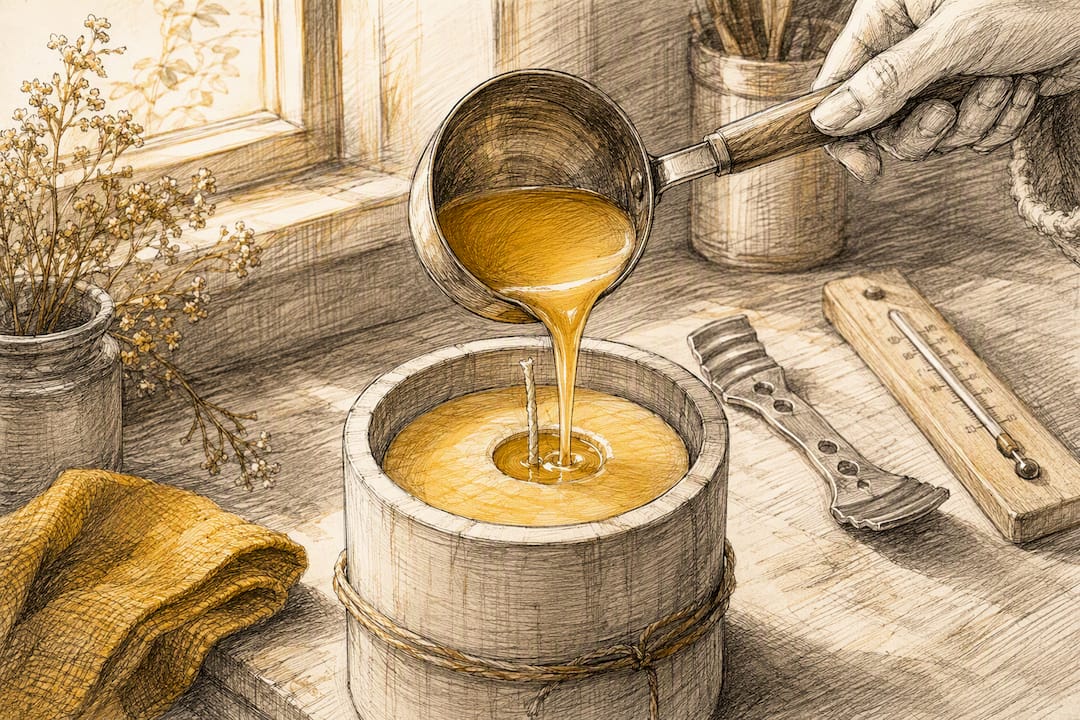
Pro Tip: A top-up poured while the candle is still slightly warm blends into the original layer almost invisibly. Wait too long and you’ll see a distinct seam line where the two pours meet.
Worked Examples: Common Mold Volumes Converted to Grams
Numbers make this easier than formulas alone, so here’s a quick reference for volumes you’ll actually run into.
A worked example ties this together. Say you have a pillar mold measuring 5 cm in diameter and 12 cm tall. Radius is 2.5 cm, so volume equals π × 2.5² × 12, which comes out to roughly 235.6 mL. Multiply by 0.96 g/mL and you need about 204 grams of beeswax, plus 10 to 20 grams in reserve depending on how deep the mold is.
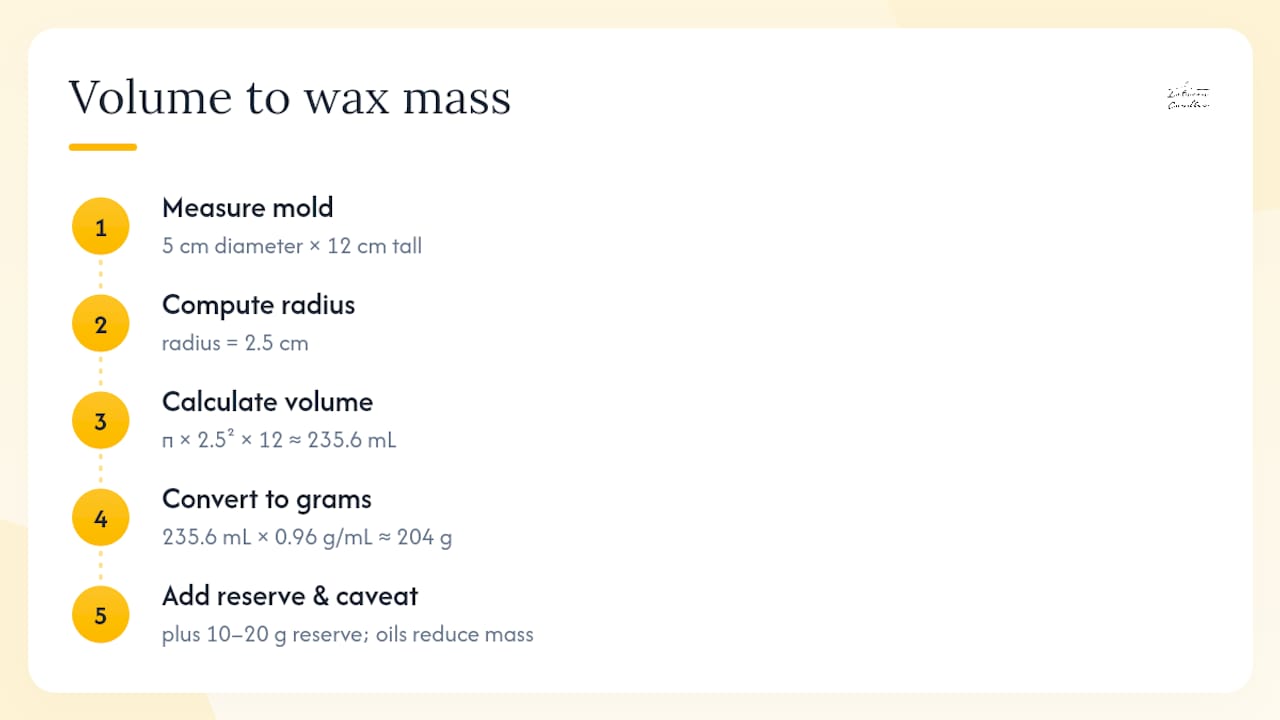
One caveat worth flagging: adding fragrance oil or essential oil shifts the total slightly, since oil is lighter than wax by volume.
For reference, this same 600 mL cavity filled to 95% with beeswax needs about 547 grams, a number worth remembering if you work with pillar molds often.
Getting Consistent Results: Scales, Jugs, and Workflow
Precision tools cost little and save a lot of wasted wax. A digital scale accurate to 1 gram handles most molds fine, but anything under 20 mL, think tea lights or wax melts, calls for a 0.1 g scale to avoid rounding errors piling up across a batch.
A few habits keep small-batch pours consistent:
- Use a heat-resistant graduated measuring jug for melting, not a random kitchen container.
- A syringe or dropper gives better control than pouring by hand for cavities under 15 mL.
- Label each melt batch with weight and fragrance load so you can repeat successful pours.
- Keep your reserve wax warm in a second small pot rather than reheating it from solid mid-pour.
- Never leave melting beeswax unattended. It ignites at high temperatures, and hot silicone molds can warp if set on an unstable surface.
Weighing your wax also beats trusting ounce labels on wax packaging, since density differences between wax types mean fluid-ounce measurements rarely match actual weight in grams.
What Mold Design Teaches You About Usable Volume
After years of designing silicone molds at Latvian Candles, one thing stands out: the number stamped on a product page rarely matches what actually fits. Wall thickness eats into interior volume more than most beginners expect, and deep bee-cell texturing or embossed detail can reduce usable space by several milliliters per cavity compared to a smooth mold of the same outer dimensions.
Flexible silicone also behaves differently under a full pour than a rigid mold does, sometimes bulging slightly and changing your effective fill line. If you want to see how pour temperature interacts with these variables, our post on pour temperature for beeswax in silicone molds covers it in more depth, alongside common fixes in our beginner mistakes guide.
— Marks
Where to Find Molds Built for These Numbers
Once you’ve run the math, the mold itself decides how well those numbers translate into a finished candle. Latvian Candles designs its 180-plus silicone mold catalog specifically around beeswax behavior, from tea-light sheets to pillar cavities to detailed taper designs, so the fill percentages in this guide apply cleanly without guesswork about wall thickness or shrinkage quirks.

If you’re new to mold-based pours, start small. Pick a single cavity design like the bee cells tea light mold or a bee cells pillar mold, run a quick water test to confirm the real volume, and compare it against your calculated grams before committing to a full batch. For anyone building a full setup from scratch, the DIY candle making starter kit bundles molds sized for these exact calculations. Have a custom sizing question or need help matching a mold to a specific candle weight? Reach out to Latvian Candles directly for guidance before you order.
Sources
A few resources are worth bookmarking alongside this guide:
- Candle Wax Calculator — Teamz Lab Tools
- Wax Weight Calculator for Candles and Soap
- How much wax will my candle mold hold? (DIY Products 101)
FAQ
Is Beeswax Density Always Exactly 0.96 g/mL?
No, it typically ranges from 0.95 to 0.96 g/mL depending on origin, but 0.96 g/mL works reliably for hobby-scale calculations.
Why Does My Beeswax Candle Sink in the Middle?
Beeswax contracts as it crystallizes during cooling, which creates a natural dip or crater in the center even when the mold was filled correctly.
How Do I Measure an Irregularly Shaped Mold?
Seal the mold, fill it with water to your intended pour line, then pour that water into a graduated jug to read the exact usable volume in milliliters.
Do I Need a Different Fill Percentage for Beeswax Than Soy Wax?
Fill percentage depends more on mold shape than wax type, but beeswax candles need 7 to 8% more grams than soy for the same volume because beeswax is denser.


