What Gives Beeswax Its Natural Scent, and Should You Add More?
Beeswax smells like honey, propolis, and faint floral volatiles carried in from pollen and nectar. That natural scent is usually enough on its own. If you want to add fragrance anyway, use a candle-grade, non-phthalate fragrance oil and test it in a small batch before you commit a full pour.
- Safety rule: stick to fragrance oils formulated and safety-tested for burning, never generic “natural” essential oils assumed to be safe.
- Next step: melt a small test batch, add your fragrance, and burn it before scaling up.
Key Takeaways
Beeswax’s natural honey and propolis scent comes from esters, fatty acids, propolis, and pollen residue, and most crafters need no added fragrance at all.
| Point | Details |
|---|---|
| Natural scent is chemical | Esters, fatty acids, propolis, and pollen volatiles combine to create beeswax’s signature honey aroma. |
| Composition shapes behavior | Beeswax runs roughly 70–75% esters, 13–15% fatty acids, and 12–15% hydrocarbons, unlike soy or paraffin. |
| Processing weakens scent | Filtering, bleaching, and deodorizing all strip aroma, so darker, less-processed wax smells stronger. |
| Fragrance needs caution | Use candle-grade, phthalate-free, non-CMR fragrance oils starting around 1–3% load, and test before scaling up. |
| Molds affect results | Latvian Candles’ silicone molds are built for beeswax’s pour temperature and shrinkage, useful for small-batch fragrance testing. |
Table of Contents
- Where does the natural smell in smaržvielas bišu vaskam come from?
- How processing and storage change beeswax’s aroma and color
- Should you add fragrance oils to beeswax, and which ones are safe?
- How do you test a beeswax fragrance blend before a full batch?
- Workshop-tested tips from Marks at Latvian Candles
- When should beeswax stay unscented?
- Ready to test your own beeswax fragrance blend?
- Sources
- FAQ
Where does the natural smell in smaržvielas bišu vaskam come from?
Beeswax’s aroma is not a single compound, it’s a mix. Three chemical families do most of the work: esters, long-chain fatty acids, and hydrocarbons. Esters carry the sweet, waxy top notes most people associate with honeycomb. Fatty acids add a slightly tangy, animalic undertone. Hydrocarbons are mostly odorless but affect how the other volatiles evaporate and reach your nose.
Beyond raw chemistry, the hive itself flavors the wax. Bees track propolis, a resin they collect from tree buds, into the comb, and propolis brings a sharp, balsamic note that lingers even after processing. Pollen and nectar residues add their own layer of floral or herbal volatiles depending on what the bees were foraging that season. This is why pure beeswax often smells pleasant without any added fragrance, and why two batches from different apiaries rarely smell identical.
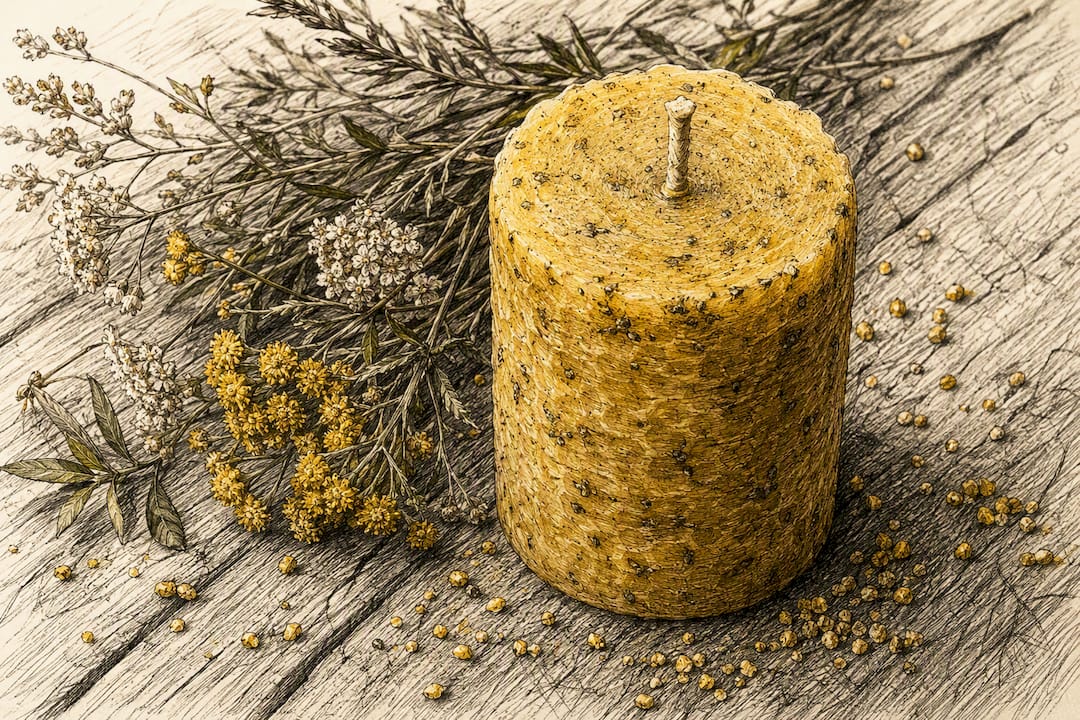
Fresh, pale comb wax tends to smell lighter and more floral, while darker comb wax, aged and rich in propolis, smells deeper and more resinous.
By the numbers: beeswax composition runs roughly 70 to 75 percent esters, 13 to 15 percent free fatty acids, and 12 to 15 percent hydrocarbons. That ratio is part of why beeswax behaves so differently from soy or paraffin when you try to scent it. It carries its own competing aroma instead of the neutral base most other waxes provide.
- Esters: sweet, waxy, honey-forward notes.
- Fatty acids: tangy, slightly animalic undertone.
- Hydrocarbons: largely odorless, but shape how scent volatilizes.
- Propolis residue: resinous, balsamic depth.
- Pollen and nectar traces: seasonal floral or herbal variation.
How processing and storage change beeswax’s aroma and color
The more a beekeeper processes raw comb, the less character the wax keeps. Filtering removes solid debris but also strips out some propolis particles. Bleaching, whether done with sunlight or chemical agents, breaks down the pigments and many of the aromatic compounds tied to them. Deodorizing goes a step further and is specifically meant to erase the natural smell, usually to prepare wax for cosmetic or industrial use where a neutral base is required.
Color is a rough proxy for how much of that original character survived. Darker, golden-amber wax usually held onto more propolis and pollen, which is exactly the material carrying its natural scent. Pale, near-white wax has typically been filtered and possibly bleached, and it smells noticeably fainter as a result.
Storage matters just as much as processing. A few habits quietly strip aroma over time:
- Storing wax in direct sunlight, which accelerates the same bleaching effect that stripping color causes.
- Keeping wax near heat sources, which lets volatile compounds evaporate slowly even without melting.
- Storing near agricultural chemicals or strong-smelling materials, which the porous wax can absorb.
- Leaving wax uncovered for long stretches, which lets scent dissipate into the air.
Pro Tip: Store cured beeswax blocks wrapped in wax paper inside an airtight container, away from windows and heaters, and check on scent strength every few months if you’re holding stock long term.
Should you add fragrance oils to beeswax, and which ones are safe?
Fragrance oils and essential oils are not interchangeable, even though craft stores often shelve them together. Fragrance oils formulated for candles are engineered to hold up under the heat of a burning wick without breaking down into acrid or sooty byproducts. Essential oils are extracted for their smell or therapeutic properties, not their combustion behavior, and many degrade or turn harsh when heated. For beeswax specifically, reach for candle-grade fragrance oils that are explicitly labeled phthalate-free and free of CMR substances (chemicals classified as carcinogenic, mutagenic, or toxic to reproduction).
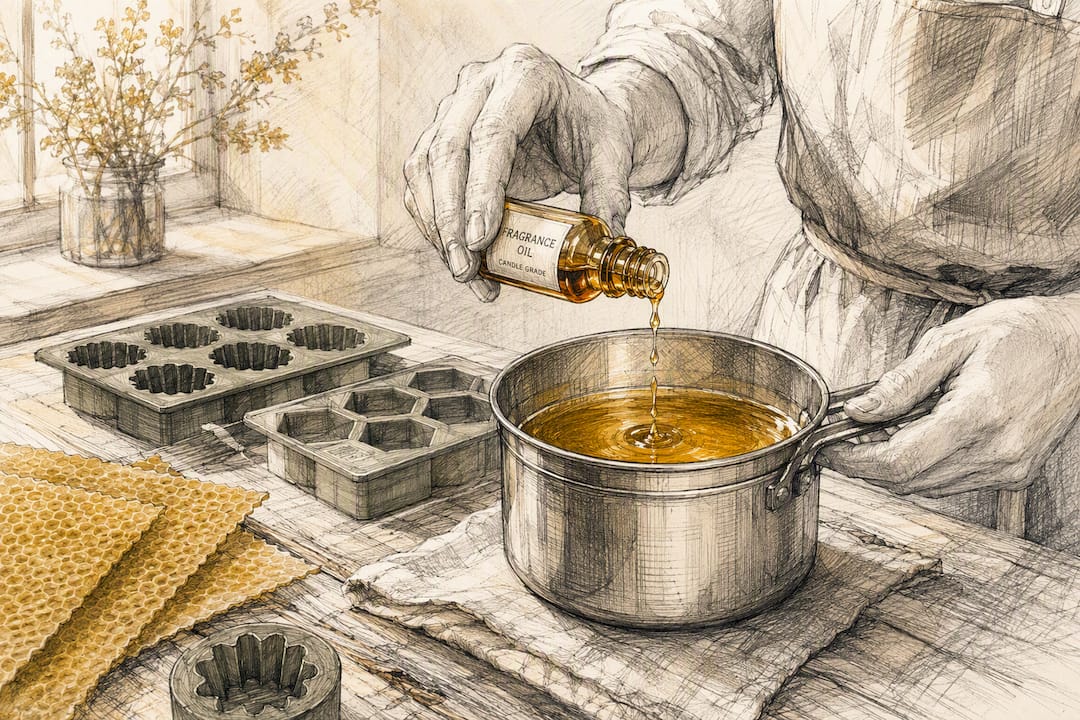
Start conservative. A practical starting range for beeswax fragrance load is relatively low, noticeably less than typical soy or paraffin blends, because beeswax’s own aroma competes with anything you add. Increase in small increments and retest rather than guessing at a higher number up front.
Watch for these warning signs that a fragrance isn’t working with your wax:
- Visible soot building up on the jar or above the flame.
- An off-odor that smells burnt or chemical rather than the intended scent.
- A weak or uneven flame, or a wick that mushrooms and drowns.
- Poor “hot throw,” meaning little to no scent released once lit.
Poor-quality or incompatible fragrance choices are a common reason scented candles smoke or burn badly, and “natural” is not a safety guarantee. Plenty of pure essential oils are simply not formulated for combustion, regardless of how safe they feel in a diffuser.
How do you test a beeswax fragrance blend before a full batch?
Run a small controlled test before committing your whole supply of wax. The process is simple and repeatable:
- Melt a small sample, around 100 to 150 grams, to roughly 71 to 82°C (160 to 180°F).
- Add your fragrance oil at the temperature the manufacturer recommends, usually a bit below the melt point.
- Stir gently for a full minute to disperse the oil evenly.
- Pour into a small test mold and let it cure undisturbed for at least 24 to 48 hours.
- Burn the test candle for a full session, tracking cold throw (unlit scent) and hot throw (scent while burning).
Check these details while it burns:
- Soot marks on the container or mold walls.
- Wick behavior, including flame height and any mushrooming.
- Scent strength at both the cold and hot throw stages.
- Visual clarity or cloudiness in the finished wax.
Keep a simple log with fragrance percentage, pour temperature, cure time, and burn notes for each test. That record is what turns trial and error into a repeatable recipe you can trust.
Workshop-tested tips from Marks at Latvian Candles
Years of pouring beeswax into silicone molds have taught the Latvian Candles workshop a few hard lessons. Pouring temperature matters more with silicone than with metal molds, and pouring slightly cooler than you would for paraffin reduces shrinkage and surface pitting.
- Add fragrance oil once the wax has cooled slightly past full melt, not at peak heat.
- Use a sturdier wick than you would for soy, since beeswax burns denser.
- Cure poured candles for at least 48 hours before the first burn test.
The most common mistakes we see are overheating the wax past what it needs, dropping fragrance in too hot, and rushing the cure. Each one quietly ruins scent throw before the candle ever gets lit.
When should beeswax stay unscented?
Pure beeswax’s honey and propolis scent is subtle enough to work in minimalist or wellness-focused candles where you want quiet, not a statement. Save added fragrance for gift or seasonal lines, where a themed scent is the whole point, and keep the load light so it complements rather than buries what the wax already offers.
— Marks
Ready to test your own beeswax fragrance blend?
If everything above has you ready to pour a test batch, the mold you use matters almost as much as the wax and fragrance ratio. Beeswax shrinks and releases differently than soy or paraffin, so a mold built for other waxes often means stuck candles, pitted surfaces, or lost detail. Latvian Candles designs its silicone molds specifically around beeswax’s higher pour temperature and denser shrinkage pattern, with over 180 designs built for clean release and sharp detail retention.

If you’re just getting started with the small-batch testing described earlier, the DIY Candle Making Starter Kit bundles molds sized for exactly that kind of test pour, so you’re not committing a full batch of wax before you know your fragrance ratio works. Browse the starter kit collection and pick a mold sized for your next test batch.
Sources
FAQ
Does beeswax need added fragrance to smell good?
No. Pure beeswax carries its own honey and propolis scent from hive residues, and many crafters leave it unscented for that reason.
What kind of fragrance oil works best with beeswax?
Choose a candle-grade fragrance oil labeled phthalate-free and free of CMR substances, since these are formulated specifically for safe combustion.
How much fragrance oil should I add to beeswax?
Start around 1 to 3 percent by weight and test a small batch before increasing, since beeswax’s natural scent competes with anything added.
Why does my scented beeswax candle smoke or smell off?
Soot and off-odors usually signal an incompatible or low-quality fragrance oil, or a fragrance load that’s too high for the wax and wick combination.
Can I use essential oils instead of fragrance oils in beeswax candles?
Most essential oils aren’t formulated for combustion and can degrade or smoke when heated, so candle-grade fragrance oils are the safer choice for burning.
What mold type works best for testing beeswax fragrance batches?
Silicone molds built specifically for beeswax’s pour temperature and shrinkage, like those from Latvian Candles, hold detail and release cleanly during small test pours.


